
 Sudhir Singh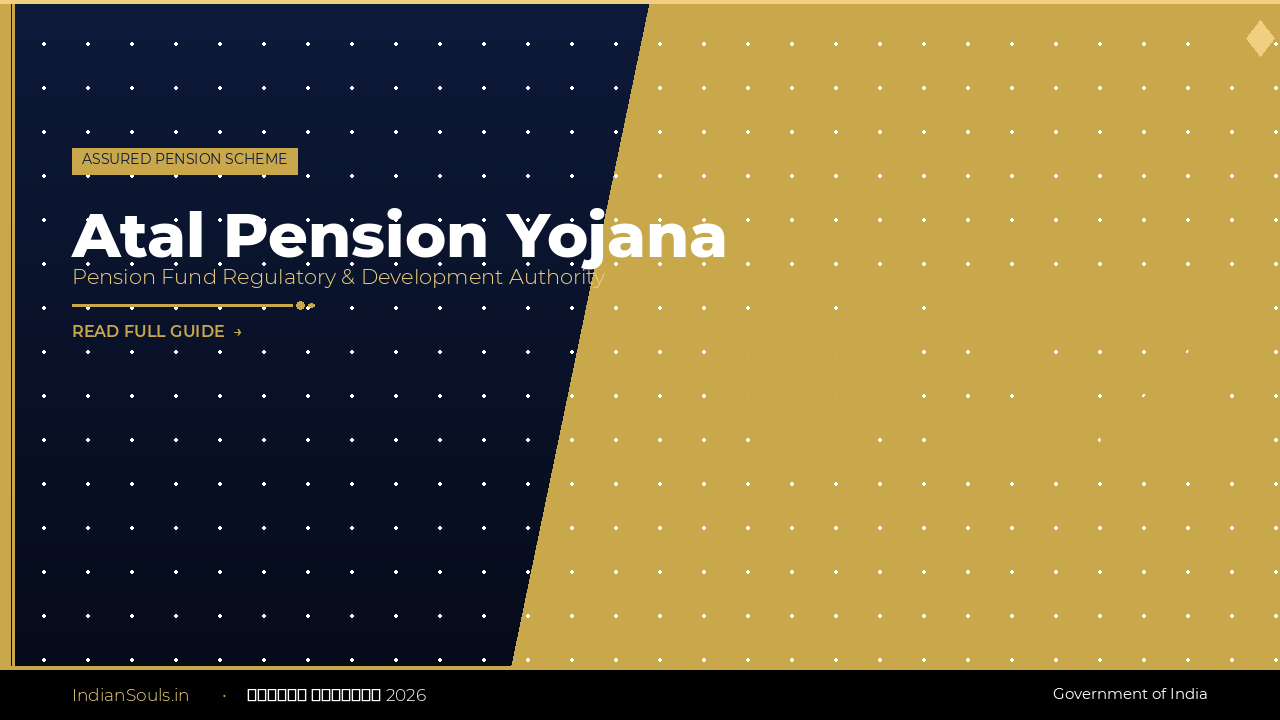
Updated on June 15, 2026
Atal Pension Yojana (APY) gives a guaranteed government-backed pension of Rs 1,000 to Rs 5,000 per month starting at age 60. The younger you join, the lower your monthly contribution. It is designed for workers without a formal pension, labourers, farmers, domestic workers, small shopkeepers, and anyone in the informal economy.
Over 7.2 crore subscribers are enrolled. If you are below 40 and in the unorganised sector, this is the most accessible pension product available in India.
The Five Pension Tiers
You choose your pension tier at the time of joining. You cannot change it later (until age 40, when you can make one change):
Rs 1,000 per month pension: Lowest contribution, smallest benefit. Rs 2,000 per month pension: Moderate contribution. Rs 3,000 per month pension: Mid-level. Rs 4,000 per month pension: Higher contribution. Rs 5,000 per month pension: Highest contribution.
All five are guaranteed by the government. If the fund underperforms, the government makes up the difference from its own pocket.
Monthly Contribution: What It Costs You
Contribution depends on the pension tier you choose AND the age at which you join. The earlier you join, the smaller the monthly deduction.
A few examples for a Rs 5,000 per month pension:
Join at age 18: Rs 210 per month. Join at age 25: Rs 376 per month. Join at age 30: Rs 577 per month. Join at age 35: Rs 902 per month. Join at age 39: Rs 1,318 per month.
For Rs 1,000 per month pension:
Join at 18: Rs 42 per month. Join at 25: Rs 76 per month. Join at 30: Rs 116 per month.
These amounts are auto-debited from your bank account every month. You do not manually pay.
Eligibility
Age: 18 to 40 years at the time of joining. After 40, you cannot join APY.
Indian citizen.
Must have a savings bank account (any bank, post office savings account also works).
Must not be a taxpayer. Income tax payers are not eligible.
Must not be covered under a statutory social security scheme, so if you are already in EPFO (provident fund from a formal job), you are excluded.
Existing NPS Tier-1 account holders: Check with your bank, some branches allow APY alongside NPS but this varies.
Government Co-Contribution (For Eligible Subscribers)
The government co-contributes 50% of the subscriber’s annual contribution (up to Rs 1,000 per year) for new subscribers who:
Joined APY between June 2015 and March 2016 AND were not income tax payers AND were not covered under EPFO or ESIC.
The co-contribution window has officially closed for new subscribers as of 2016. Current new joiners do not get the government co-contribution. However, the guaranteed pension at 60, regardless of fund returns, is still a strong benefit over market-linked plans where returns are uncertain.
How to Enrol
Through your bank: Visit any bank where you have a savings account. Ask the relationship manager for an APY enrolment form. Fill it, submit with a passport photo and Aadhaar, and the monthly auto-debit starts from the following month.
Online through banking apps: Most major banks: SBI, PNB, BOB, HDFC, ICICI, Axis, Canara, allow APY enrolment directly from their net banking or mobile banking app. Look for “Government Schemes” or “APY” in the menu.
Through the National Pension System portal: Visit npscra.nsdl.co.in and follow the APY section.
Post office savings account: If you bank with the post office, walk into your nearest head post office and ask for APY enrolment.
Nominee and Survivor Pension
When you die after 60, your spouse continues receiving the same pension amount for their lifetime. After both of you pass away, the nominee (usually a child) receives the accumulated corpus as a lump sum.
If you die before turning 60, your spouse can either continue contributing until 60 and then receive the pension, or withdraw the full accumulated corpus immediately.
Choose your nominee and spouse details carefully at the time of enrolment. You can update them later through your bank.
Premature Exit
You can exit APY before age 60 only under specific circumstances: death or a terminal illness. Normal voluntary exit before 60 means you get back only your contributions plus interest earned, not the full accumulated corpus (since the government’s notional contribution does not pay out on early exit).
From October 2022, voluntary exits before 60 for income tax payers are not allowed. For non-tax payers below 60 wishing to exit, the option exists but the financial loss is significant.
The general advice: join at the lowest tier you can afford, commit for the long term. Even Rs 42 per month from age 18 gives you a guaranteed Rs 1,000 monthly pension for life from age 60.
APY and E-Shram Together
Unorganised workers who register on E-Shram (28 crore workers enrolled) should also enrol in APY through their bank using their E-Shram UAN as supporting identity. The two are complementary: E-Shram gives identity and accident insurance, APY gives retirement security. We covered E-Shram registration at indiansouls.in/e-shram-card-2026/.
If you also want market-linked retirement savings alongside APY, NPS Vatsalya (for children) and the regular NPS Tier 2 (for flexible withdrawals) are options. Our NPS Vatsalya guide is at indiansouls.in/nps-vatsalya-scheme-2026/.
Key Links
Enrol: Through your bank or post office directly.
NPS/APY info: npscra.nsdl.co.in
APY helpline: 1800-889-1030 (toll-free, PFRDA)
Check APY statement: Log in to your bank’s net banking and look under “APY” in the government schemes section.
📩 If you notice any incorrect data in this guide or wish to share additional information, please write to us at info@indiansouls.in.
Over 2000+ Government Schemes & Policies Simplified
Indian Souls is your guide to government Schemes, scholarships, pensions, subsidies, job exams, and more. We break complex schemes into easy steps, helping every citizen take full advantage of the opportunities available.
No jargon. No confusion. Just useful info that helps indian citizen.






![12 Government Schemes for Urban Poor Must Know About [2025 Guide]](https://indiansouls.in/wp-content/uploads/2025/05/image-1.jpg "12 Government Schemes for Urban Poor Must Know About [2025 Guide] - Indian Souls")

 Sudhir Singh








%20–%20Rates,%20How%20to%20Open%20and%20Benefits)


%20–%20A%20Complete%20Guide)

%202026)

%20–%202025%20Complete%20Guide:%20Latest%20Updates,%20How%20It%20Works%20&%20Who%20Qualifies)

)


