The “Salary Slip” Mystery: A Complete Guide to Employee Pension Scheme (EPS) 2026

Updated on December 12, 2025

Let’s look at your salary slip for a second.

You see a big number at the top called “Gross Salary” or “CTC.” Then, you look at the bottom right, the “Net Salary” or “In-Hand,” and it’s significantly lower. You see deductions like PF, Professional Tax, and maybe TDS.

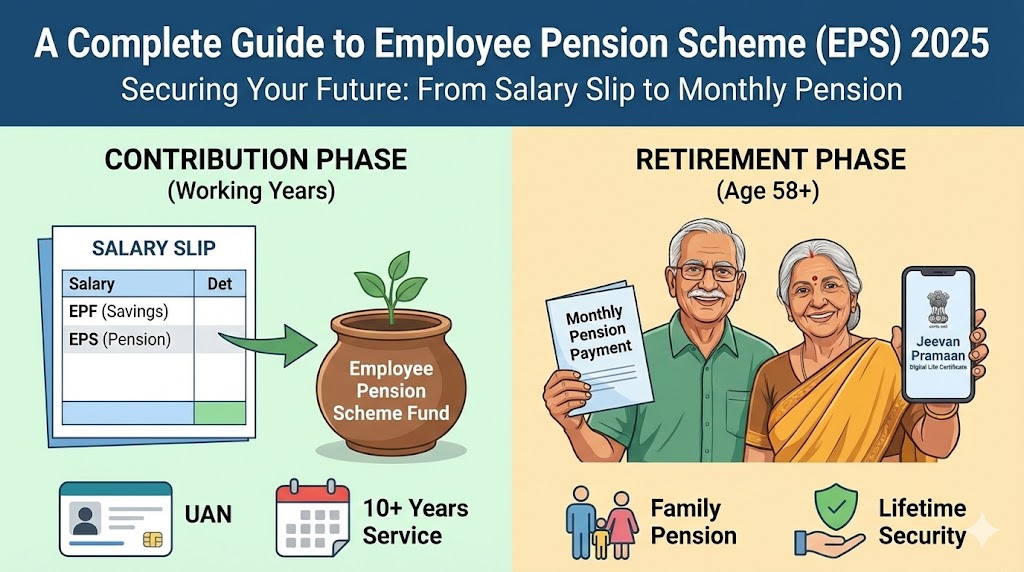
We all know EPF (Employee Provident Fund)—that’s the big pot of money you get when you retire or switch jobs. But there is a silent, often ignored component hidden inside those deductions called the EPS (Employee Pension Scheme).

Most Indians treat EPS as “dead money.” They don’t know how it works, they don’t know how to calculate it, and worse, they often lose it by withdrawing their PF incorrectly.

In 2025, with retirement planning becoming critical, you cannot afford to ignore this. Here is your “No-Jargon” guide to understanding the Employee Pension Scheme.


1. EPF vs. EPS Employee Pension Scheme: The “Brother-Sister” Confusion

First, let’s clear the biggest confusion.

EPF is your Savings.

EPS is your Insurance/Pension.

When your employer deducts 12% from your basic salary + DA:

  • Your 12% goes entirely into your EPF (Savings).
  • Employer’s 12% is split:
    • 3.67% goes to your EPF.
    • 8.33% goes to your EPS (Pension).

The Catch (The ₹15,000 Cap):

For years, the government capped the EPS contribution. Even if your basic salary was ₹50,000, the 8.33% was calculated only on a maximum wage ceiling of ₹15,000.

  • Max contribution to EPS per month = ₹1,250 (8.33% of 15,000).
  • The rest of the employer’s share went into EPF.

(Note: The “Higher Pension” option changed this for some, which we will discuss later.


2. The “Golden Ticket”: The 10-Year Rule

This is the most important rule of the entire scheme.

You are eligible for a monthly pension ONLY if you have completed 10 years of service.

  • Scenario A (Less than 10 years): If you quit your job after 4 years, you generally withdraw your PF. You can also withdraw your EPS money as a lump sum (using Form 10C). You get cash, but no monthly pension later.
  • Scenario B (More than 10 years): Once you cross 10 years of service (across one or multiple companies), you become a “Member for Life.” You cannot withdraw the EPS money as a lump sum anymore. Instead, you get a Scheme Certificate, and when you turn 58, the government starts paying you a monthly pension until death.

Human Pro Tip:

If you have worked for 9 years and 6 months, try to work for another 6 months before taking a break. Crossing that 10-year line guarantees you a safety net for life.


3. How Much Pension Will I Actually Get? (The Formula)

In 2025, assuming you are on the standard scheme (capped at ₹15,000 wage ceiling), here is the math.

The Formula:

The "Salary Slip" Mystery: A Complete Guide to Employee Pension Scheme (EPS) 2026
  • Pensionable Salary: Average of your Basic + DA over the last 60 months of service (Capped at ₹15,000 for standard cases).
  • Pensionable Service: Number of years you worked. (If you work more than 20 years, you get a bonus weightage of +2 years).

Example: The Case of “Ravi”

Ravi retires at age 58 after working for 30 years.

  • His calculation salary is capped at ₹15,000.
  • His service is 30 years + 2 bonus years = 32 years.

The "Salary Slip" Mystery: A Complete Guide to Employee Pension Scheme (EPS) 2026

Wait, that’s it? ₹6,800?

Yes. Under the standard scheme, EPS was never meant to be a luxury retirement plan; it was meant to be a basic survival safety net for the industrial workforce.


4. The “Higher Pension” Buzz (The 2025 Context)

You might have heard colleagues talking about a Supreme Court ruling or “Joint Options.”

What happened?

The Supreme Court allowed employees to opt for a Higher Pension on Actual Salary.

This means if your Basic Salary is ₹1 Lakh, you can contribute 8.33% of ₹1 Lakh (₹8,330) to EPS instead of the capped ₹1,250.

The Trade-off:

  • Pros: Your monthly pension could jump from ₹7,000 to ₹30,000 or more.
  • Cons: A huge chunk of your EPF corpus (the lump sum you get at retirement) will be transferred to the Pension fund to pay for this.
  • Status in 2025: Most eligible employees have already submitted their Joint Options. If you opted for this, your formula changes, and your pension will be significantly higher, but your retirement lump sum cash will be lower.

5. When Can I Withdraw? (Age Matters)

You don’t get the money the day you retire. The age brackets are strict.

  1. Age 58 (Superannuation): You get the Full Pension. You must have left the job.
  2. Age 50 to 57 (Early Pension): If you leave your job between age 50 and 57 and don’t plan to work again, you can ask for an “Early Pension.”
    • The Catch: Your pension amount is reduced by 4% for every year you are younger than 58. It’s usually better to wait until 58.
  3. Age 60 (Deferred Pension): You can delay your pension until age 60. The government gives you a bonus of 4% for every year you delay.

6. Family Pension: The Safety Net

This is the most “human” part of the scheme. EPS isn’t just for you; it’s for your family.

  • Widow/Widower Pension: If the member dies (even while in service), the spouse gets a monthly pension for life (minimum ₹1,000, usually 50% of the member’s pension).
  • Child Pension: Two children below the age of 25 receive 25% of the widow’s pension amount each.
  • Orphan Pension: If both parents pass away, the children receive 75% of the widow’s pension amount.

Note: This applies even if the employee dies after just 1 month of service, contributed was deposited. This is why EPS is called “Insurance.”


7. Leaving a Job? Don’t Make This Mistake

When young people switch jobs, they often withdraw their PF.

  • The Mistake: They fill out Form 19 (for EPF) and Form 10C (for EPS). They take the cash and run.
  • The Consequence: Your “Service History” resets to zero. If you join a new company, you start from Day 1. You lose the chance to build that 10-year history for a lifetime pension.

The Right Way:

When switching jobs, transfer your PF and EPS using the UAN portal. Do not withdraw unless you are unemployed for more than 2 months and desperately need the money.


8. How to Check Your EPS Balance

In 2025, checking this is digital and easy.

  1. EPFO Portal: Login to the Member e-Sewa portal with your UAN.
  2. Passbook: Download your Passbook.
  3. Look for Column 2: You will see a column for “Pension Contribution.” This shows the accumulation of that 8.33%.
    • Note: The passbook shows the contribution amount, not the future pension amount. The pension amount is calculated only when you apply for it (Form 10D).

9. The Digital Life Certificate (Jeevan Pramaan)

For those already receiving a pension (or for your parents):

You must prove you are alive every year to keep getting the money.

Gone are the days of going to the bank manager. In 2025, you can use Face Authentication on an Android phone using the Jeevan Pramaan App. Just blink at your phone camera, and your certificate is submitted.


Summary Table: EPS at a Glance

FeatureDetails
Who contributes?Employer (8.33% of Basic Salary).
Minimum Service10 Years required for Monthly Pension.
Retirement Age58 Years (for full pension).
If Service < 10 YrsYou get a Lump Sum Withdrawal (Table D).
If Service > 10 YrsYou get a Scheme Certificate (Pension Guarantee).
Minimum Pension₹1,000 per month (under review for increase).

Final Thoughts: It’s Not Just “Small Change”

It is easy to dismiss EPS because the monthly amount looks small compared to current inflation. But ask any retired person about the value of a guaranteed monthly income that arrives on the 1st of every month, regardless of stock market crashes or bank interest rate drops.

It is your right. It is your money. Ensure your UAN is active, your service history is merged, and your nominee details are updated.

Secure your old age today.

📩 If you notice any incorrect data in this guide or wish to share additional information, please write to us at info@indiansouls.in.

Over 2000+ Government Schemes & Policies Simplified

Indian Souls is your guide to government Schemes, scholarships, pensions, subsidies, job exams, and more. We break complex schemes into easy steps, helping every citizen take full advantage of the opportunities available.

📌 1.5M+ Readers Reached
📝 5K+ Queries Resolved
💡 1L+ Citizens Benefiting
📚 500+ Verified Scheme Guides
🎓 Scholarship Alerts & Exam Prep
🌍 Smart Travel & Subsidy Tips
Find Hidden Government Schemes!

No jargon. No confusion. Just useful info that helps indian citizen.

The "Salary Slip" Mystery: A Complete Guide to Employee Pension Scheme (EPS) 2026 - Indian Souls
Sudhir Singh

As the Head of Strategy and Growth for Indian Souls, I lead the technical and editorial mission to bridge the gap between complex government policy and the everyday Indian citizen. With over 5 years of experience in digital architecture and performance marketing, I have dedicated my career to building high-impact platforms that simplify over 1500+ central and state government schemes, scholarships, and welfare initiatives for over 1.5 million readers. My background is a unique blend of technical engineering and strategic content leadership. As the founder of Notioncue.com, I specialize in the full lifecycle of digital products, from WordPress architecture and AI-integrated coding to advanced Server-Side Analytics (GA4/GTM). My work ensures that critical information is not just published, but accessible, fast, and optimized to reach the people who need it most. My Areas of Expertise Civic Tech & Content Strategy: Transforming dense regulatory frameworks into clear, actionable guides for farmers, students, and entrepreneurs. Full-Stack Web & App Development: Expert-level WordPress customization, app creation, and building scalable digital infrastructures. Advanced Data Analytics: Specialist in technical SEO, Webmaster Tools, and applied analytics (IIT Bombay methodology). Growth Engineering: Leading end-to-end digital marketing and inbound strategies for global brands across the US, India, and Saudi Arabian markets. Honors & Certifications Executive Program in Digital Marketing & Applied Analytics – IIT Bombay Certifications: Fact-Checking Fundamentals (IFCN), Content Marketing, Inbound Marketing, and Email Marketing (HubSpot Academy). Awards: Recipient of the Award for Professional Excellence and Rising Star for innovation in digital governance and content leadership.

More Government Schemes

Jan Dhan Yojana (PMJDY) – Account Opening, Balance and Benefits Complete Guide

Pradhan Mantri Jan Dhan Yojana offers zero-balance bank accounts with accident insurance, overdraft facility, and RuPay debit card. Eligibility, how to open online, and account benefits explained.

Post Office RD Scheme – Recurring Deposit Interest, Maturity and How to Open

Post Office Recurring Deposit (RD) lets you save a fixed amount monthly at 6.7% interest over 5 years. Learn current rates, how to open online, maturity calculation, and loan facility.

NPS National Pension System – How to Open an Account and Claim Tax Benefits

National Pension System (NPS) lets any Indian build a retirement corpus with market-linked returns. Learn how to open an NPS account online, tax benefits under 80CCD, and withdrawal rules.

Post Office Savings Schemes – All 9 Schemes Compared

Compare all 9 Post Office savings schemes: interest rates, tenure, tax benefits, and minimum deposit. Find which scheme suits your savings goal in 2026.

PM SVANidhi Scheme – Rs. 50,000 Loan for Street Vendors: Complete Guide

PM SVANidhi gives street vendors loans from Rs. 10,000 to Rs. 50,000 at subsidised interest. Check eligibility, how to apply, and how to get the next higher loan after repayment.

Post Office Fixed Deposit (TD) – Rates, How to Open and Benefits

Post Office Fixed Deposit (Time Deposit) offers up to 7.5% interest. Check current rates, how to open online or at a post office, 80C benefit, and premature withdrawal rules.

NPS Vatsalya Scheme – Pension Account for Your Child Explained

NPS Vatsalya lets parents open a pension account for their minor child with just Rs. 1,000 per year. Learn how it works, benefits, how to open an account, and what happens at age 18.

UAN Member Portal Login – How to Activate, Check PF and Transfer

Step-by-step guide to UAN Member Portal login, activation, PF balance check, passbook download, KYC update, and online PF transfer at unifiedportal-mem.epfindia.gov.in.

Income Tax eFiling Guide – How to File ITR Online Free

File your income tax return (ITR) online free at incometax.gov.in. Step-by-step guide for salaried employees using ITR-1 Sahaj. AY 2026-27 deadline and tips.

Atal Pension Yojana 2026: Guaranteed Rs 1,000 to Rs 5,000 Monthly Pension After 60: Who Can Join, Monthly Contribution, and How to Enrol

Atal Pension Yojana (APY) gives a guaranteed government-backed pension of Rs 1,000 to Rs 5,000 per month starting at age 60. The younger you join, the lower your monthly contribution. It is designed f…

PM Mudra Yojana 2026: How to Get a Loan Up to Rs 20 Lakh for Your Small Business: Eligibility, Banks, and Application

PM Mudra Yojana has been running since 2015 and has disbursed over 57.79 crore loans worth Rs 40.07 lakh crore across India. Applications are open right now for 2026….

PMJJBY and PMSBY: Two Government Schemes That Actually Deliver What They Promise

Most government insurance schemes come with a catch. Either the premium is too high for the average Indian household, or the claim process is so complicated that families give up…

TReDS Platform India: Faster Payments for MSMEs, Explained

If you run a small manufacturing unit or a services firm that supplies to large corporations, you already know the drill. You deliver the goods, raise the invoice, and then…

What Is PHCS Insurance?

You got a new job, signed up for the health plan your employer offered, and then noticed something odd on your insurance card: a logo that says PHCS Insurance. No…

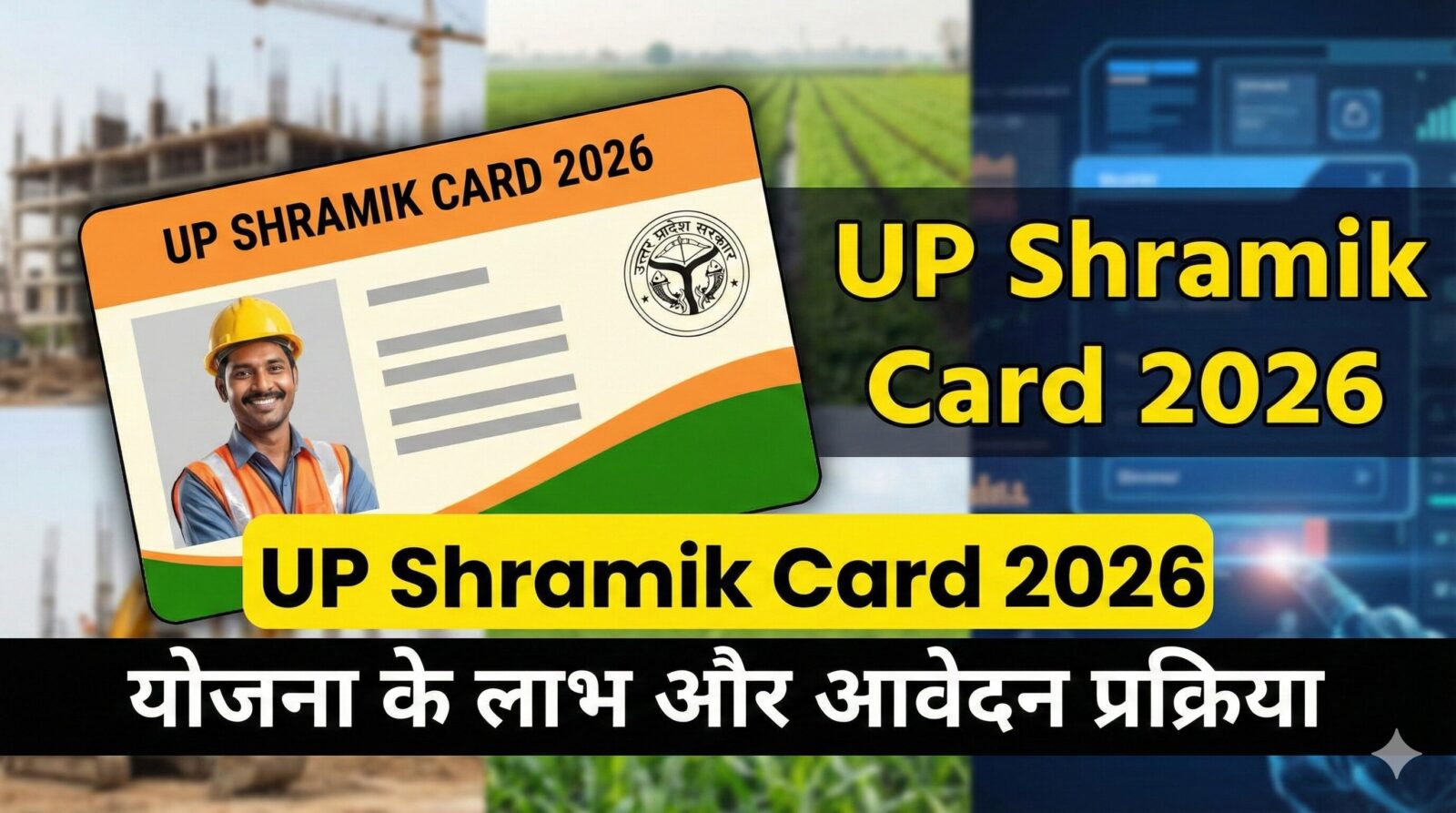
UP Shramik Card 2026: Comprehensive Guide to Benefits, Eligibility, and Application

The UP Shramik Card, also known as the UP Labour Card or Majdur Card, is an official identity card issued by the Uttar Pradesh Building and Other Construction Workers Welfare…

Don’t Let Them Loot You! A Common Man’s Guide to Consumer Rights in India

By: A Consumer Rights Concerned Citizen (20 Years of Experience Fighting for Rights) Namaste friends. My name does not matter. What matters is that I am just like you. I…

Pradhan Mantri Mudra Yojana (PMMY) – A Complete Guide

The Pradhan Mantri Mudra Yojana (PMMY) is one of the most widely used credit support schemes in India. Over more than 15 years of writing about government schemes and interacting…

JanSamarth Portal – National Portal for Credit Linked Government Schemes

Over the last 15 years of writing about government welfare programs, I have often seen one consistent challenge for citizens. People know about government loan schemes, but they struggle to…

PM Vishwakarma Yojana Complete Guide : Scheme Overview, Objectives & Eligibility

The PM Vishwakarma Yojana is a flagship initiative by the Government of India aimed at empowering traditional artisans and craftspeople. Designed to provide holistic support and recognition, this scheme bridges…

RajSSP (Rajasthan Social Security Pension) – 2025 Complete Guide: Latest Updates, How It Works & Who Qualifies

Introduction In a small village in Rajasthan, a senior farmer sits under the shade of a tree, anxiously checking his phone for the direct-deposit alert that comes on pension day.…

IRDA Bima Sugam Portal Launched: Insurance Marketplace for All Insurance

Bima Sugam is a unified digital insurance marketplace being built under the supervision of the Insurance Regulatory and Development Authority of India (IRDAI). The official website for the Bima Sugam…

Start‑up India Exemption: 3 Proven Ways to Pay Zero Tax for Three Years (Powerful, Legit)

If your start-up qualifies, you can pick any three years in your first ten years and pay no income tax on profits for those years. Not a reduced rate. Not…

Udyam Registration 2025: Complete Guide to Starting a Certified MSME

Registering as an MSME under the Udyam registration portal is not just about formalizing your business. It opens doors to exclusive government schemes, legal safeguards, and easier finance. Whether offering…

GST Registration – Ultimate Step by Step Guide

For GST registration as a Normal Taxpayer/ Composition/ Casual Taxable Person/ Input Service Distributor (ISD)/ SEZ Developer/ SEZ Unit, perform the following steps: Submitting Registration Application for Normal Taxpayer/ Composition/…

PMSBY Scheme – Pradhan Mantri Suraksha Bima Yojana

Life is full of beautiful moments, but sometimes, it can also throw unexpected challenges our way. We all want to protect our loved ones and ensure their well-being, no matter…

12 Government Schemes for Urban Poor Must Know About [2025 Guide]

Want affordable housing? Looking for job training? Need better living conditions? This guide covers 12 essential government schemes for the urban poor in 2025 that could change your life. From…

11 Government Business Loan Scheme That Get Instant Approval in 2025

Small businesses drive over 40% of India’s total GDP, and government loan schemes have become their backbone. But getting enough funding remains the biggest problem for entrepreneurs who want to…

Government Schemes for Pregnant Women and New Mothers in India

The Government of India has launched several comprehensive schemes to support pregnant women and new mothers, aiming to improve maternal health, reduce mortality, and ensure the well-being of both mother…

Top 15 Government Schemes for Farmers in India

India’s agricultural sector stands on the dedication of more than 120 million farming households who manage rising input costs, volatile crop prices, and climate-related risks daily. To strengthen the agricultural…

SSP Scholarship: A Complete Guide to Karnataka’s State Scholarship Portal

Introduction Education is the foundation of a bright future, but financial constraints often become a hurdle for many students. Recognizing this challenge, the Government of Karnataka has taken a proactive…

Index