
 Sudhir Singh
Updated on April 14, 2026
If you run a small manufacturing unit or a services firm that supplies to large corporations, you already know the drill. You deliver the goods, raise the invoice, and then wait. Thirty days. Sixty days. Sometimes ninety. That wait doesn’t just test your patience; it starves your working capital at exactly the moment you need it to run operations, pay suppliers, or take on the next order.
This is the problem the TReDS platform India was built to fix. It’s been around since 2014, it’s regulated by the RBI, and it has quietly moved tens of thousands of crores of MSME invoices off the waiting list and into bank accounts, usually within 48 hours. Yet most small business owners still haven’t heard of it, or if they have, they’re fuzzy on how it actually works.
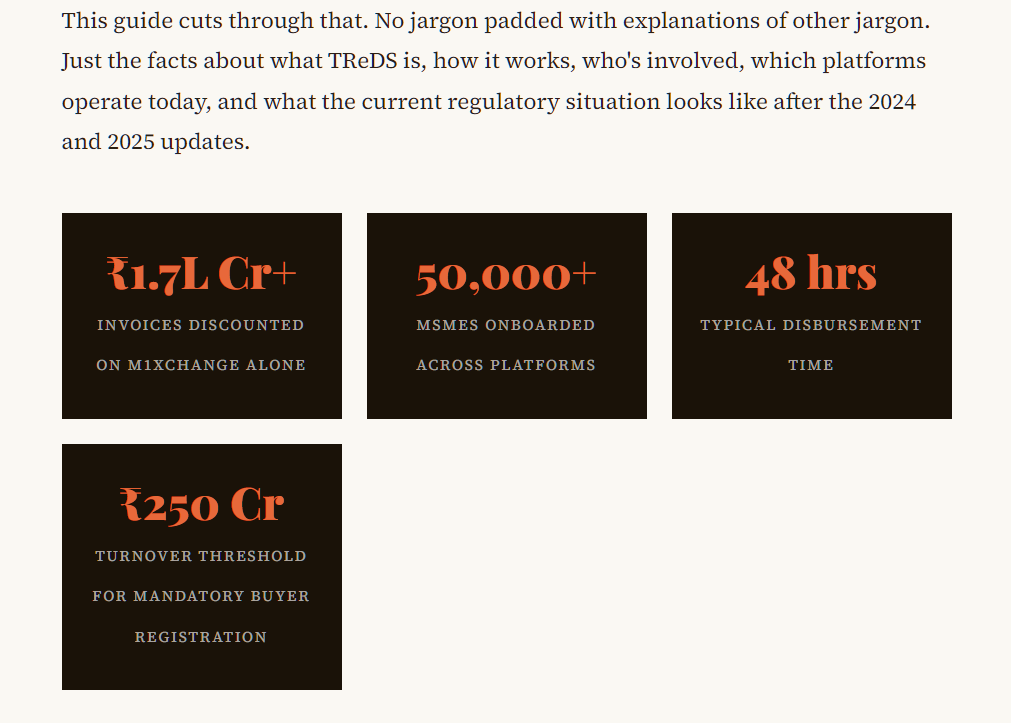
This guide cuts through that. No jargon padded with explanations of other jargon. Just the facts about what TReDS is, how it works, who’s involved, which platforms operate today, and what the current regulatory situation looks like after the 2024 and 2025 updates.
Key Statistics
- ₹1.7L Cr+: Invoices discounted on M1xchange alone
- 50,000+: MSMEs onboarded across platforms
- 48 hrs: Typical disbursement time
- ₹250 Cr: Turnover threshold for mandatory buyer registration
1. What TReDS Actually Is?
TReDS stands for Trade Receivables Discounting System. It is an electronic platform that allows MSMEs to convert their unpaid invoices into immediate cash by auctioning them to financiers such as banks and NBFCs.
Think of it as a digital marketplace where your invoice becomes a tradeable asset. You’ve done the work, the buyer owes you money, and instead of waiting for the payment cycle to close, you sell that claim to a financier at a small discount. The financier collects from the buyer later. You get your money now.
The Reserve Bank of India launched TReDS on 3 December 2014 to solve the liquidity crunches faced by MSMEs arising out of delayed payments by corporate buyers and government entities. The concept isn’t entirely new; factoring and invoice discounting have existed in some form for decades, but TReDS brought it onto a regulated, transparent, digital platform where multiple financiers compete on rates.
“Your invoice is already an asset. TReDS just gives you a market to sell it before the buyer’s payment cycle ends.”
2. The Cash Flow Problem It Solves
India’s MSME sector is not small. MSMEs contribute roughly 37% of the total GDP and play a vital role in the Indian economy. But the payment reality for most small suppliers is brutal. Large buyers routinely take 60 to 90 days to pay, and in some industries, the actual average stretches longer than that.
An MSME sitting on three months’ worth of receivables has to somehow keep paying its workers, buying raw materials, and servicing any existing loans, all out of whatever cash it managed to hold back. Traditional financing options don’t help much. Bank loans need collateral that small businesses often can’t provide. Overdraft limits are tied to balance sheet size. And the paperwork takes time that a cash-starved business doesn’t have.
MSMEs often operate on thin margins and rely heavily on timely payments to run their businesses. Traditional financing options like bank loans or overdrafts come with challenges, including collateral requirements, high interest rates, and lengthy approval cycles.
TReDS sidesteps most of that. Unlike traditional financing, TReDS does not require MSMEs to pledge assets or provide guarantees. The receivables are discounted based on the buyer’s credit rating, not the MSME’s balance sheet. If you supply to a creditworthy large company, your invoices become fundable even if your own credit history is thin.
3. How TReDS Works, Step by Step
The process is fully digital and involves three parties: the MSME seller, the corporate buyer, and the financier (bank or NBFC). A fourth participant, insurance companies, was added in 2023 to improve risk management. Here’s the sequence:
- MSME uploads the invoice: After delivering goods or services, the MSME uploads the invoice onto the TReDS platform. This is the trigger for the entire process.
- Buyer authenticates the invoice: Once uploaded, invoices are authenticated by the buyers of goods and services. This authentication is the key step: it converts the invoice from a claim into a verified, fundable instrument.
- Financiers place competing bids: Financiers, meaning banks and NBFCs, bid against the verified and approved invoice. Because multiple financiers compete, the MSME gets a market-driven rate rather than whatever a single bank decides to offer.
- MSME accepts the best bid: The MSME reviews the bids and selects the most favorable discounting rate. The difference between the full invoice value and the discounted amount is the financing cost.
- Funds disbursed within 24 to 48 hours: Upon acceptance, funds are disbursed to MSMEs within 24 hours, without collateral and with no recourse, transferring the risk of default to buyers.
- Buyer repays the financier on the due date: When the original invoice due date arrives, the buyer pays directly to the financier rather than the MSME. The MSME’s obligation ends when the bid is accepted.
Invoices processed through TReDS, referred to as factoring units, are digitised and tradeable, and are accorded the status of negotiable instruments under the Negotiable Instruments Act, 1881, granting them legal enforceability comparable to cheques. That legal weight matters: it gives financiers the confidence to lend and MSMEs the assurance that the transaction is enforceable.
4. The Three Active TReDS Platforms in India
Three TReDS platforms are presently operational in India: Receivables Exchange of India Ltd (RXIL), M1xchange, and Invoicemart. Each is RBI-licensed, follows the same regulatory framework, but differs in its ownership, scale, and ecosystem focus.
| Platform | Promoted By | Key Fact |
| RXIL | SIDBI & NSE | Set up in December 2014, RXIL is a TReDS platform that bridges the gap between buyers, sellers, and financiers. It also operates RXIL Global IFSC for international trade financing. |
| M1xchange | Mynd Solutions | Started in April 2017, M1xchange has onboarded 66+ banks, 2,500+ corporates, and 50,000+ MSMEs. It has facilitated discounting of invoices worth more than Rs. 1,70,000 crore. |
| Invoicemart | A.TREDS (Axis Bank & mjunction) | Focused on the manufacturing and engineering supply chain, Invoicemart is another RBI-licensed marketplace for MSME invoice financing. |
All three platforms are interoperable in the sense that the underlying rules are RBI-set, but MSMEs and buyers need to register on the specific platform where they want to transact. Some larger buyers maintain a presence on more than one platform, which gives MSME suppliers more options.
5. Who Must Register on TReDS?
This is where things got a lot more concrete in late 2024. Voluntary participation was always possible, but the government issued a notification that changed the equation for large buyers.
Mandatory Registration Timeline
- 2018 Notification: All central PSUs and companies with a turnover above Rs. 500 crore were required to register on TReDS.
- November 2024 Notification: The threshold was lowered to Rs. 250 crore, with a mandatory registration deadline of March 31, 2025.
- All Central PSEs: Mandatory regardless of turnover, with no exceptions.
- MSMEs: Registration is voluntary. There’s no compulsion on the seller side, only on large buyers.
The said companies and CPSEs must complete their onboarding on the TReDS platforms by March 31, 2025. The rationale is straightforward: the platform only works if buyers are present to authenticate invoices. Mandating large buyer registration forces the demand side of the marketplace to show up, which in turn makes it viable for MSMEs to participate.
In practice, compliance has been uneven. Only around 2,500 buyers are currently registered on TReDS, a figure significantly below the estimated number of eligible entities. Corporate reluctance is often attributed to concerns over invoice transparency, auto-debit mandates, and exposure of proprietary supply chain data.
6. What MSMEs Actually Gain?
The headline benefit is faster cash, but the details matter more than the headline.
No Collateral Required
This is the one that changes things for small businesses with no land, machinery, or stock to pledge. TReDS democratizes access to credit, especially for businesses in semi-urban and rural areas, because the receivables are discounted based on the buyer’s credit rating, not the MSME’s balance sheet. If the buyer is a well-rated PSU or large corporate, the MSME’s own creditworthiness is largely irrelevant.
Competitive Rates Through Bidding
Because banks and NBFCs bid against each other for the same invoice, buyers accept the lowest bids, thereby reducing the cost for MSMEs and passing that saving on to customers while MSME suppliers get enough money to turn around their business. A single-lender arrangement can’t offer that kind of rate discipline.
Zero Recourse Risk
MSMEs pass on the risk of receivables to the financiers by selling their receivables. The risk of default transfers to buyers, not back to the MSME. If the buyer fails to pay on the due date, the financier bears that credit risk, not the small supplier who already delivered goods in good faith.
Full Digital Transparency
Every transaction on TReDS is digital, traceable, and RBI-compliant. MSMEs gain visibility into when and how much they will be paid, enabling better financial planning. For an owner who has spent years chasing payments with no real tracking, this alone is a meaningful change.
Better Working Capital Management
By converting invoices into cash quickly, the TReDS platform empowers MSMEs to reinvest, restock, and expand without getting trapped in a cash flow crunch. That reinvestment ability, compounded over many invoice cycles in a year, can meaningfully accelerate business growth.
7. The Real Challenges Holding TReDS Back
TReDS works well on paper. The mechanics are sound, the legal framework is solid, and the RBI has invested in the system for over a decade. The gap is in adoption, and most of that gap comes from the buyer side.
Buyer Reluctance Is the Core Problem
Adoption is hindered by buyer resistance as various large corporates remain reluctant to engage on TReDS due to concerns around transparency, auto-debit mandates, and exposure of supply chain data. This reluctance limits MSME access and transaction volume.
To put that in plain terms: a large company’s finance team may not want its payment practices to be fully visible and digital. Auto-debit means the company can’t quietly delay payments past the due date. Supply chain data on the platform could, in theory, reveal vendor relationships to competitors. These aren’t irrational concerns, even if the net result is that MSMEs keep waiting.
Enforcement Remains Weak
While registration is mandated for companies with turnover above Rs. 250 crore by March 31, 2025, compliance is often superficial. Some buyers register on the platform but process few invoices, avoiding the platform’s actual intent. For TReDS to achieve systemic impact, enforcement must evolve from passive monitoring to active deterrence, backed by real-time audits and meaningful penalties.
Low MSME Awareness
On the supplier side, awareness is still patchy. Many small business owners have never heard of TReDS, or they’ve heard of it but don’t know which platform to use or how to get started. The onboarding process, while improving, still requires paperwork and a buyer already on the platform to transact with. That dependency on buyer presence creates a chicken-and-egg situation.
8. RBI’s 2025 Reforms: What’s Changing
The RBI has been paying close attention to TReDS participation rates, and the proposals it floated in early 2025 are the most substantive changes to the system in several years.
The RBI has proposed removing the due diligence requirement during MSME onboarding onto TReDS platforms. By eliminating this requirement, the RBI intends to encourage more MSMEs to participate in the platform, which remains underutilised despite its benefits.
This is a practical fix. The due diligence step added time and paperwork to an onboarding process that small businesses, often without dedicated finance teams, found difficult to navigate. Removing it doesn’t mean removing oversight; it means shifting the verification burden away from the point of entry so more MSMEs can get started faster.
The RBI is also conducting a comprehensive review of TReDS guidelines and has invited public feedback on the proposed changes. In 2023, insurance companies were added as the fourth participant, enhancing risk management and expanding the platform’s scope. The addition of insurers is significant because it can reduce the risk premium that financiers factor into their bids, which should, over time, bring discounting rates down further for MSMEs.
9. Frequently Asked Questions
What is the TReDS platform India in simple terms?
TReDS is an electronic platform that allows MSMEs to convert their unpaid invoices into immediate cash by auctioning them to financiers such as banks and NBFCs. The MSME gets paid quickly at a small discount; the financier collects the full amount from the buyer on the original due date.
Is TReDS only for large MSMEs?
No. Any MSME registered under the MSMED Act can participate, regardless of size. The key requirement is that the corporate buyer must also be registered on the same platform. Since buyer registration is now mandatory for companies above Rs. 250 crore turnover, the pool of eligible buyer-MSME pairs is growing.
What is the cost for an MSME to use TReDS?
The cost is the discounting rate, the spread between the invoice face value and the amount the MSME receives. Because multiple financiers bid competitively, rates are market-driven and generally lower than what a single bank or NBFC would quote. The exact rate depends on the buyer’s credit profile and current market conditions.
What happens if the buyer defaults on payment to the financier?
The risk of default transfers to buyers, not back to the MSME. MSMEs pass on the risk of receivables to the financiers by selling their receivables. The MSME’s liability ends once the bid is accepted and funds are disbursed.
Which TReDS platform should an MSME choose?
The most practical answer is: whichever platform your buyer is registered on. If your buyer is on RXIL, you register on RXIL. If they’re on M1xchange or Invoicemart, you follow them. Some buyers are present on multiple platforms, which gives you rate comparison flexibility.
Is TReDS regulated by the RBI?
Yes. The Reserve Bank of India oversees TReDS, guaranteeing that transactions are carried out in a transparent and safe environment. Platforms must maintain a minimum Rs. 25 crore capital base and adhere to strict governance norms set by the RBI.
The Bottom Line
TReDS is not a new idea, but it’s an underused one. The mechanics work, the legal framework is sound, and the regulatory momentum is, for once, moving in a direction that actually favours small suppliers rather than just large buyers.
The real barrier isn’t the platform. It’s getting enough large buyers to actively participate, not just register. The 2024 mandate lowering the threshold to Rs. 250 crore and the 2025 RBI simplification proposals are steps in the right direction, but they only work if they’re enforced with real consequences for non-compliance.
For any MSME supplying to a corporate or government buyer with a turnover above Rs. 250 crore, the conversation about TReDS is worth having now. Not because it’s mandated on your end, but because your buyer is required to be there, and that changes the equation entirely.
📩 If you notice any incorrect data in this guide or wish to share additional information, please write to us at info@indiansouls.in.
Over 2000+ Government Schemes & Policies Simplified
Indian Souls is your guide to government Schemes, scholarships, pensions, subsidies, job exams, and more. We break complex schemes into easy steps, helping every citizen take full advantage of the opportunities available.
No jargon. No confusion. Just useful info that helps indian citizen.



![12 Government Schemes for Urban Poor Must Know About [2025 Guide]](https://indiansouls.in/wp-content/uploads/2025/05/image-1.jpg "12 Government Schemes for Urban Poor Must Know About [2025 Guide] - Indian Souls")
















 Rajesh Tanwar



%20–%20A%20Complete%20Guide)

%202026)

%20–%202025%20Complete%20Guide:%20Latest%20Updates,%20How%20It%20Works%20&%20Who%20Qualifies)

)


)

:%207%20Key%20Benefits%20&%20Complete%20Guide%20for%20Secure%20Retirement)


