
 Sudhir Singh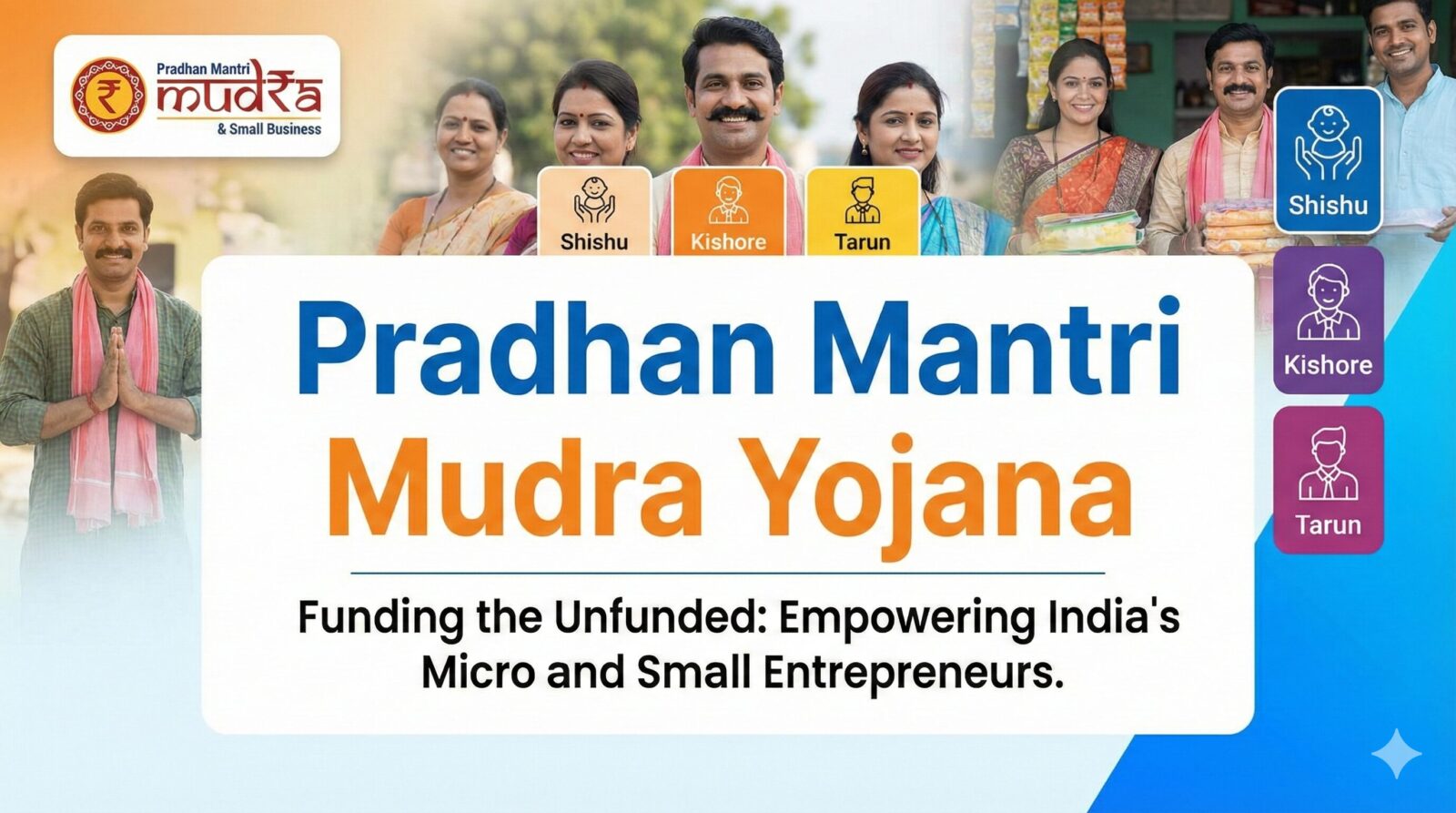
Updated on December 27, 2025
The Pradhan Mantri Mudra Yojana (PMMY) is one of the most widely used credit support schemes in India. Over more than 15 years of writing about government schemes and interacting with entrepreneurs, bankers, business owners and loan applicants, I have seen how access to affordable finance can change lives and livelihoods, especially in small towns, villages and emerging urban markets.
In this article, we explain the Mudra scheme in detail, based on official structure and practical experiences. We cover eligibility, loan categories, application process, documents, repayment, common questions, risks and benefits to business owners. We also include the latest updates for 2025 and 2026, and clarify misconceptions that often confuse applicants.
Introduction: What Is Pradhan Mantri Mudra Yojana?
Pradhan Mantri Mudra Yojana (PMMY) is a credit support scheme launched by the Government of India on 8 April 2015 to provide institutional, collateral-free credit to micro and small enterprises. The objective is to support business activities that generate income but may not have access to formal credit due to a lack of security or an established credit history. The loans are given through banks, regional rural banks, non-banking financial companies (NBFCs) and micro finance institutions.
The scheme is implemented under the Micro Units Development and Refinance Agency Ltd (MUDRA), a government entity created to oversee refinancing support to lenders and expand credit flow to micro units.
| Aspect | Details |
|---|---|
| Scheme Name | Pradhan Mantri Mudra Yojana |
| Launch Year | 2015 |
| Target Group | Micro and small entrepreneurs |
| Loan Nature | Collateral free |
| Maximum Loan Limit | ₹20 lakh |
| Implementing Institutions | Banks, RRBs, NBFCs, MFIs |
| Sector Covered | Manufacturing, trading, services |
Why PM Mudra Yojana Matters
In my experience working with lenders and borrowers, a common barrier for small ventures is access to credit without collateral. Traditional lenders often require security or an established credit history. Many women entrepreneurs, youth starting their first venture, shopkeepers, artisans and small manufacturers find it difficult to secure a loan under these conditions.
Mudra loans have changed that by offering institutional credit up to ₹20 lakh without collateral, making formal finance accessible and affordable for new and existing enterprises.
The scheme has played a key role in financial inclusion, self-employment generation and economic participation of underserved segments. In practice, it has brought many informal ventures into the formal credit system.
Loan Structure Under PMMY
PMMY classifies loans into categories based on the size and phase of the business. This categorisation helps match finance with need and risk level.
Loan Categories
| Category | Loan Amount Range | Suitable For |
|---|---|---|
| Shishu | Up to ₹50,000 | New and very small businesses |
| Kishore | ₹50,001 to ₹5,00,000 | Growing micro enterprises |
| Tarun | ₹5,00,001 to ₹10,00,000 | Established businesses |
| Tarun Plus | ₹10,00,001 to ₹20,00,000 | Businesses with good repayment history |
The new Tarun Plus category was introduced after the 2025 federal budget, doubling the upper loan limit to ₹20 lakh for eligible borrowers. This expansion aims to help small enterprises that have already established credit discipline and now need higher funds for scaling business operations. AajTak
Who Can Apply for Pradhan Mantri Mudra Yojana?
The scheme is aimed at non-corporate, non-farm micro and small enterprises engaged in various economic activities. A few examples include:
- Shopkeepers, traders and service providers
- Artisans and craftsmen
- Small manufacturing units
- Transport operators
- Retail businesses
- Food and hospitality micro-enterprises
Eligibility hinges mainly on three elements:
- Business must be income-generating
- It must belong to the manufacturing, trading or services sector
- Applicant must be an Indian citizen aged 18 years or above with a viable business proposition Google Translate
Businesses in purely agricultural activities, such as crop farming,g are generally excluded under this scheme, though allied agri services may qualify.
Purpose and Uses of Mudra Loans
Mudra loans are versatile and can be used for legitimate business purposes, including:
- Working capital requirements
- Purchase of tools, equipment or machinery
- Expansion of operations
- Purchase of inventory and stock
- Marketing and business development expenses
- Transport vehicles for goods or services
In practice, I have come across small transport operators who used Mudra loans to buy vehicles. I have also seen food businesses, tailoring units, and cottage industries use these loans to upgrade equipment and expand output. Such use cases contribute to local employment and self-reliance.
Latest Update on Loan Limit and Structure
A major update in 2025–2026 is the increase in the maximum loan amount under the scheme to ₹20 lakh, with the introduction of the Tarun Plus category. This change reflects the government’s intent to support enterprises beyond early-stage finance, enabling them to take bigger steps in scaling. The eligibility for Tarun Plus generally requires prior successful repayment of a high-category loan, creating a pathway for credit progression.
This update significantly broadens the scope of Mudra loans, making them useful for equipment-intensive micro enterprises, expanding inventories and investing in technology or modernisation.
Interest Rates and Repayment Terms
Interest rates for Mudra loans differ across banks and lending institutions. They are typically linked to each institution’s base rate or EBLR plus a margin. Repayment terms vary depending on loan amount and usage, but the overall tenor can extend to several years with a moratorium period depending on business cashflow patterns.
Borrowers need to understand the terms before signing the agreement, as these affect business cash flow. In my discussions with applicants and bank officials, a transparent understanding of interest and repayment flexibility reduced defaults and improved loan outcomes.
Application Process
You can apply for a Mudra loan in two ways:
Offline
- Visit your nearest bank branch that participates in PMMY
- Request the Mudra loan application form
- Fill in business and personal details
- Attach documents such as Aadhaar, PAN, address proof, business plan, and bank statements.
- Submitthe form and await processing.
Banks then evaluate the business viability and repayment capacity before sanctioning the loan.
Online
Digital processes have simplified access. You can apply through:
- Bank portals offering Mudra loan application
- Government-supported platforms, such as PSB LOANS in 59 Minutes, where initial approval up to ₹10 lakh can be obtained based on digital underwriting
Online applications help reduce turnaround time and avoid repeated visits to bank branches.
Documents Required
Key documents that banks typically require include:
- Aadhaar card
- PAN card
- Proof of business or proposed activity
- Bank account passbook or statement
- Business plan or project report
- Address proof
- Photograph of the applicant
In practice, preparing these documents well before the application reduces delays.
Benefits and Practical Impact
Over the last decade, Mudra has made credit accessible to tens of crore borrowers. According to official reports, a large volume of loans has been sanctioned across categories, enabling the growth of micro-enterprises and supporting livelihoods nationwide.
I have witnessed women entrepreneurs in small towns use these loans to establish tailoring units and beauty salons. Youth in semi-urban areas have taken small loans to start transport services or digital services like repair shops.
Risks and Challenges
A loan product of this scale is not without challenges. A notable issue in 2025 is the rise in non-performing assets (NPA) associated with Mudra loans under scheduled banks. As of March 2025, the NPA ratio was reported to be near 9.8 per cent, indicating stress in parts of the portfolio.
Certain districts have seen challenges in recovery, especially where businesses faced downturns or inadequate planning. In one state, over 23,000 accounts under Mudra were classified as NPA, with banks bearing financial stress.
These developments underscore the need for borrowers to prepare business plans carefully and for lenders to balance growth with credit discipline.
Frequently Asked Questions (Q&A Format)
Who is eligible fora Mudra loan?
Any Indian citizen aged 18 and above who runs or proposes to start a micro enterprise in non-farm sectors like manufacturing, trading or services can apply. The business must generate income and demonstrate repayment capacity.
What is the maximum amount available under PMMY?
The maximum loan amount is ₹20 lakh under the Tarun Plus category for borrowers who have successfully repaid previous loans. Standard categories include Shishu, Kishore and Tarun.
Is collateral required?
No collateral is required for loans up to ₹20 lakh under PMMY. This makes it distinct from many traditional loans.
Can I apply online?
Yes. Many banks allow online application directly through their portals. Additionally, digital credit platforms can provide initial approval workflows.
Does Mudra loan attract a subsidy?
Mudra loans themselves do not carry explicit subsidies, but they often include credit guarantee cover under government arrangements, reducing risk for lenders.
Key Takeaways
- Pradhan Mantri Mudra Yojana provides collateral-free credit up to ₹20 lakh for micro enterprises.
- Loans are categorised as Shishu, Kishore, Tarun and Tarun Plus based on funding needs.
- The scheme has played a significant role in extending formal credit to millions of small business owners.
- Recent changes in the loan limit expand support for scaling enterprises.
- Borrowers and lenders must balance credit growth with repayment planning to manage NPA risks.
The Pradhan Mantri Mudra Yojana remains a cornerstone of India’s credit ecosystem for small business development. For many micro and small enterprises, timely access to formal credit under clear terms and digital convenience can be the difference between stagnation and sustainable growth. If you are planning to start or expand a venture, careful planning, proper documentation and understanding of repayment conditions will help you use this scheme effectively.
📩 If you notice any incorrect data in this guide or wish to share additional information, please write to us at info@indiansouls.in.
Over 2000+ Government Schemes & Policies Simplified
Indian Souls is your guide to government Schemes, scholarships, pensions, subsidies, job exams, and more. We break complex schemes into easy steps, helping every citizen take full advantage of the opportunities available.
No jargon. No confusion. Just useful info that helps indian citizen.


























 Rajesh Tanwar


![12 Government Schemes for Urban Poor Must Know About [2025 Guide]](https://indiansouls.in/wp-content/uploads/2025/05/image-1.jpg "12 Government Schemes for Urban Poor Must Know About [2025 Guide] - Indian Souls")



)


)
%202026)


%20–%202025%20Complete%20Guide:%20Latest%20Updates,%20How%20It%20Works%20&%20Who%20Qualifies)
,%20Eligibility%20&%20Status%20Check)


:%2010000%20Rs.%20Monthy%20Stipened)
