Swachh Bharat Mission (SBM) – Swachh Smart Toilets

Updated on September 25, 2025

Before 2014, many Indian families, especially in rural and poor urban areas, did not have a toilet at home. Open defecation was common, which led to disease, unsafe conditions for women, and loss of dignity. The Swachh Bharat Mission (SBM) was launched to solve this problem by making sanitation a right for every Indian. Toilets became the centrepiece of this mission.


What Is an SBM Toilet?

An SBM toilet refers to a toilet built under the Swachh Bharat Mission, supported by government funding, local authorities, and citizen participation. The focus is not only on construction but also on use, maintenance, and long-term cleanliness.


Types of Toilets Provided

SBM includes different categories so that every citizen, whether in a crowded city or a remote village, has access:

  1. Individual Household Toilets (IHHLs): For families who didn’t have one earlier.
  2. Community Toilets: Shared facilities where household toilets are not practical (e.g., slums, high-density areas).
  3. Public Toilets: Located in markets, bus stations, schools, and other public spaces for travellers and visitors.

This flexible model ensures that no one is left behind.

Read More: Simple Guide to Using the EPFO UAN Member Portal (For Employees)


How the Scheme Works

  • Financial Help: Eligible households receive financial assistance from the government to build a toilet.
  • Monitoring: Toilets are geo-tagged and tracked through mobile apps and dashboards, ensuring transparency.
  • Partnerships: Local governments, NGOs, and private partners also help with awareness and construction.
  • Behaviour Change Campaigns: Building toilets alone is not enough. SBM ran campaigns like “Darwaza Band” to encourage families to actually use them.

Health and Social Impact

Research shows that SBM toilets have led to real changes in society:

  • Better Child Health: A study published in Nature (2024) found that improved sanitation access under SBM directly reduced infant and under-five mortality rates. Simply put, more toilets = healthier children.
  • Faster Decline in Infant Mortality: Between 2015 and 2020, India’s infant mortality fell three times faster compared to the earlier decade, partly due to sanitation improvements.
  • Women’s Safety and Dignity: Toilets at home mean women no longer need to go out in the dark or unsafe places.
  • Cleaner Neighbourhoods: Streets, open fields, and rivers are less polluted, improving the environment for everyone.

Numbers at a Glance

  • Over 100 million toilets built under SBM (urban and rural combined).
  • ODF (Open Defecation Free) towns and villages: Thousands declared ODF, with monitoring through third-party checks.
  • Urban Coverage: SBM Urban alone has built lakhs of household, community, and public toilets across cities.

Source: PIB

Pointers from CSC Data under SBM (G)

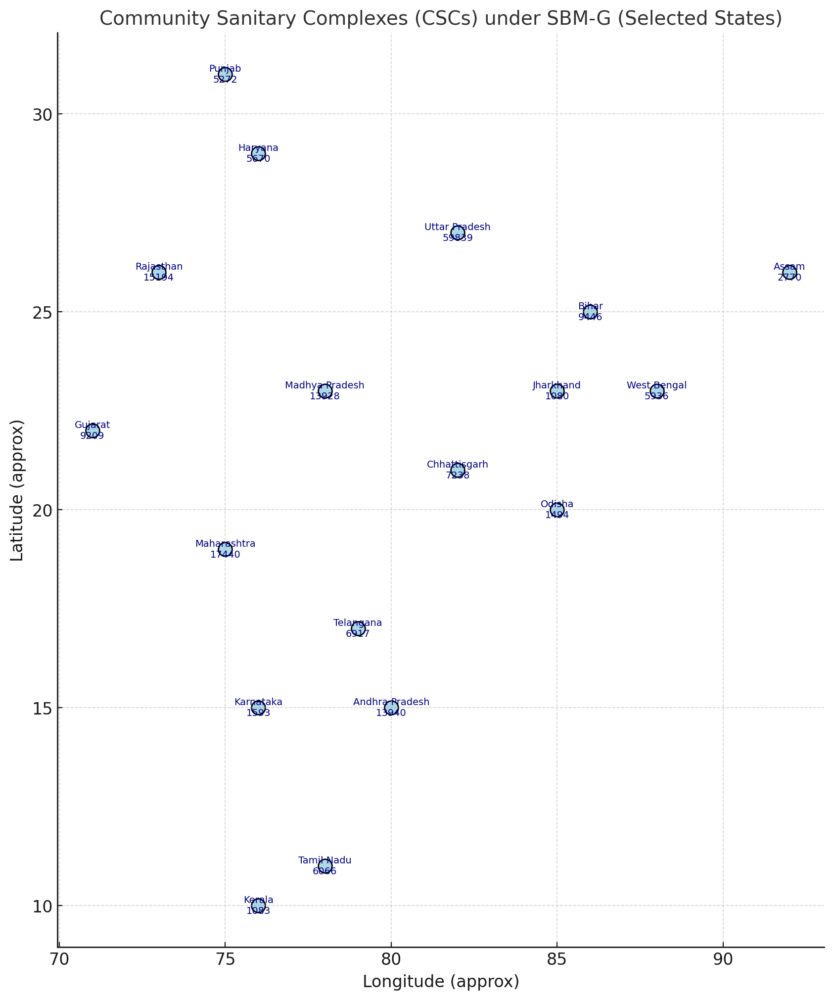
  • As of the report, 2,00,868 CSCs have been built across India under SBM-Gramin.
  • Construction is demand-based, so progress varies widely across states.

States with the Highest CSC Numbers (Cumulative)

  • Uttar Pradesh: 59,839 (the single largest share in the country).
  • Maharashtra: 17,440 CSCs.
  • Rajasthan: 15,194 CSCs.
  • Andhra Pradesh: 13,940 CSCs.
  • Madhya Pradesh: 13,928 CSCs.

These states together account for nearly 60% of total CSCs in India.

Read More: Government Schemes for India’s Unemployed Youth


Smaller States/UTs with Low CSC Numbers

  • Puducherry: 10 CSCs (lowest).
  • Dadra & Nagar Haveli and Daman & Diu: 53.
  • Tripura: 200.
  • Ladakh: 302.
  • Andaman & Nicobar Islands: 309.

These regions likely depend more on individual household toilets due to smaller populations.


Construction in the Last 3 Years (2019–20 to 2021–22)

  • Peak Year: 2020–21 saw the maximum construction with 97,757 CSCs built, followed by 52,868 in 2019–20 and 28,069 in 2021–22.
  • This shows a big push during 2020–21, possibly linked to the ODF sustainability drive and COVID-19 sanitation focus.

States Showing Massive Jumps

  • Uttar Pradesh: From almost negligible (3 CSCs in 2019–20) to 55,499 in 2020–21.
  • Bihar: From 3 in 2019–20 to 8,390 in 2020–21.
  • Rajasthan: Big leap in 2020–21 with 8,544 CSCs, followed by 2,858 in 2021–22.
  • Madhya Pradesh: From 469 in 2019–20 to 9,673 in 2020–21.

States with Steady but Moderate Progress

  • Tamil Nadu: Consistently building (1,576 in 2019–20, 1,507 in 2020–21, and 2,604 in 2021–22).
  • Kerala: Balanced numbers each year (258 → 251 → 403).
  • Assam: Gradual scale-up with 330 → 1,496 → 669.

Read More: Government Schemes for Women Entrepreneurs


States with Declines or Low Momentum

  • Mizoram: 414 in 2019–20, dropped sharply to 72 in 2020–21, and zero in 2021–22.
  • Goa: 521 in 2019–20, but only 1 CSC in 2021–22.
  • Nagaland: Numbers dropped from 350 in 2020–21 to just 29 in 2021–22.

Key Insights

  • Regional Variation: North Indian states (UP, Bihar, Rajasthan, MP) account for the bulk of CSCs due to larger rural populations.
  • ODF+ Push: 2020–21 was the turning point with record CSC construction across many states.
  • Sustainability Focus: Even after achieving ODF status in 2019, construction continued to support new households and rural growth.
  • Equity Gaps: Smaller states and UTs may need focused interventions to ensure all communities get equal access.

Challenges That Remain

While SBM has achieved a lot, there are still issues that need attention:

  • Usage vs. Construction: Some households built toilets but do not use them regularly, often due to water shortages or old habits.
  • Maintenance: Public and community toilets need better upkeep to stay clean and functional.
  • Flood-Prone Areas: In states like Bihar, toilets in low-lying areas sometimes become unusable during monsoon floods.
  • Sewage Management: Building toilets is one side of the coin; safe disposal of waste is equally important, and many towns still lack proper sewage systems.

How to Apply for an SBM Toilet

  1. Online: Visit the official SBM Urban portal and apply under the individual household toilet scheme.
  2. Offline: Approach your local Urban Local Body (ULB), Gram Panchayat, or Municipal Corporation office with Aadhaar, proof of residence, and photographs.
  3. Community/Public Toilets: If individual toilets are not possible, the ULB will guide you to nearby community or public facilities.

The Bigger Picture: Why SBM Toilets Matter for India

  • They bring health benefits, reducing diarrheal diseases and deaths in children.
  • They promote gender equality by giving women privacy and dignity.
  • They improve school attendance, especially for girls who previously skipped classes due to lack of toilets.
  • They support environmental sustainability, as less waste ends up in fields and water bodies.

Conclusion

The SBM toilet initiative is more than a government project—it’s a movement that reshaped how India views sanitation. With millions of toilets built and significant improvements in health and dignity, it stands as one of the largest public health campaigns in the world.

The next step is ensuring consistent usage, proper maintenance, and safe waste treatment so that the gains of SBM become permanent and future generations inherit a cleaner, healthier India.

📩 If you notice any incorrect data in this guide or wish to share additional information, please write to us at info@indiansouls.in.

Over 2000+ Government Schemes & Policies Simplified

Indian Souls is your guide to government Schemes, scholarships, pensions, subsidies, job exams, and more. We break complex schemes into easy steps, helping every citizen take full advantage of the opportunities available.

📌 1.5M+ Readers Reached
📝 5K+ Queries Resolved
💡 1L+ Citizens Benefiting
📚 500+ Verified Scheme Guides
🎓 Scholarship Alerts & Exam Prep
🌍 Smart Travel & Subsidy Tips
Find Hidden Government Schemes!

No jargon. No confusion. Just useful info that helps indian citizen.

Swachh Bharat Mission (SBM) – Swachh Smart Toilets

Sudhir Singh

Sudhir Singh is an accomplished writer & engineer whose work has appeared on leading platforms such as Socialnomics, Hackernoon, HealthWorks Collective, Clutch, and The Good Men Project. Today, His focus has shifted towards social issues and government initiatives that directly affect Indian lives. Emphasizing the importance of credibility and trust in every piece he writes, Sudhir channels his expertise into shedding light on policies, social change, and the transformative role of technology in society. He continues to empower Indian Souls through incisive commentary and thoughtful analysis. Follow Sudhir on LinkedIn .

More Government Schemes

UP Shramik Card 2026: Comprehensive Guide to Benefits, Eligibility, and Application

The UP Shramik Card, also known as the UP Labour Card or Majdur Card, is an official identity card issued by the Uttar Pradesh Building and Other Construction Workers Welfare…

Don’t Let Them Loot You! A Common Man’s Guide to Consumer Rights in India

By: A Consumer Rights Concerned Citizen (20 Years of Experience Fighting for Rights) Namaste friends. My name does not matter. What matters is that I am just like you. I…

Pradhan Mantri Mudra Yojana (PMMY) – A Complete Guide

The Pradhan Mantri Mudra Yojana (PMMY) is one of the most widely used credit support schemes in India. Over more than 15 years of writing about government schemes and interacting…

Lakshmir Bhandar Scheme West Bengal – Eligibility, Amount, Application Process

The Lakshmir Bhandar Scheme is one of the most impactful social welfare schemes launched by the Government of West Bengal for women. Introduced to provide direct financial assistance to women…

Pandit Dindayal Upadhyay Rajya Karmchari Cashless Chikitsa Yojana

I have covered many health welfare programs for state government employees over the last decade. This scheme stands out because it addresses a need I saw again and again during…

Haryana’s Contractor Saksham Yuva Scheme 2026 Complete Guide : From Engineering Graduate to Govt. Contractor

In a landmark move to combat unemployment among technical graduates, the Haryana Government has officially notified the ‘Contractor Saksham Yuva Scheme’. This initiative is a direct pipeline for unemployed engineers…

Dr. Ambedkar Scheme for Social Integration through Inter-Caste Marriages (2025 Guide)

The Dr Ambedkar Scheme for Social Integration through Inter-Caste Marriages is a central government initiative aimed at breaking down caste barriers and promoting social unity in India. By offering a…

MJPJAY 2025-26: Mahatma Jyotiba Phule Jan Arogya Yojana (MJPJAY)

Medical emergencies don’t knock before entering. One day life is normal, and the next day, a doctor is asking for ₹2 Lakhs for a sudden heart surgery or knee replacement.…

A Complete Guide to Maharashtra’s Gharkul Yojana 2026

For every family in India, there is one dream that stands above all others. It isn’t buying a car, and it isn’t going on a fancy vacation. It is the…

RajSSP (Rajasthan Social Security Pension) – 2025 Complete Guide: Latest Updates, How It Works & Who Qualifies

Introduction In a small village in Rajasthan, a senior farmer sits under the shade of a tree, anxiously checking his phone for the direct-deposit alert that comes on pension day.…

MPTAAS Scholarship Portal 2026 :  Registration on (tribal.mp.gov.in), Eligibility & Status Check

Summary: The MPTAAS Scholarship is a post-matric financial aid program by the Madhya Pradesh government for SC, ST, and eligible OBC students pursuing studies after Class 10. It covers tuition…

Ladka Bhau Yojana 2026 : Eligibility, Benefits, & Online Application

The Maharashtra Government started the Ladka Bhau Yojana 2026 to help unemployed youth by offering free skill training and a monthly stipend of up to ₹10,000. The main aim of…

MNSSBY Bihar Student Credit Card Yojana: Check Status and Apply Online

MNSSBY Bihar Student Credit Card Scheme is an education program of the Bihar government to grant students loans for higher studies. Launched in the year 2016. The objective of this government…

Indira Gandhi Smartphone Yojana: A Comprehensive Overview

The Indira Gandhi Smartphone Yojana was a significant initiative launched by the Government of Rajasthan in August 2023. The scheme aimed to empower women and female students by providing them…

Mukhyamantri Rajshri Yojana 2025: Support for the Girl Child

The Mukhyamantri Rajshri Yojana is one of Rajasthan’s key welfare schemes launched to improve the status of girls from birth to higher education. It offers financial assistance to families at…

Kanya Sumangala Yojana Grant of ₹25000

Kanya Sumangala Yojana is a conditional cash assistance scheme of the Uttar Pradesh government providing financial support to girls at key life and education milestones. In 2025, the total benefit…

Maiya Samman Yojana : Rs 2,500 for Women

Mukhyamantri Maiya Samman Yojana is a welfare scheme of the Jharkhand government that gives monthly financial support to eligible women. In 2025, the stipend was raised to ₹ 2,500 per…

Swasthya Sathi Health Insurance Scheme Complete Guide

Swasthya Sathi is the flagship health insurance scheme of West Bengal, offering cashless hospitalization up to ₹ 5 lakh per family per year.

Free Laptop Yojana across Indian States – Fact Checks

In 2025, multiple Indian states are running or planning substantial Free Laptop Yojana or cash grant schemes for meritorious students.

NREGA / MGNREGA: A Comprehensive & Practical Guide

“I’ve visited dozens of panchayats and talked with field staff — the gaps are in implementation, not in understanding the law.” What is NREGA (MGNREGA)? At its core, NREGA is…

Poshan Abhiyaan Jan Andolan 2025: Poshan Maah Tracker, App Download and Data Entry

India’s fight against malnutrition took a decisive turn in March 2018 when Prime Minister Narendra Modi launched the Poshan Abhiyaan (Prime Minister’s Overarching Scheme for Holistic Nourishment) in Jhunjhunu, Rajasthan. Poshan Abhiyaan…

Mukhyamantri Seekho Kamao Yojana (MMSKY): 10000 Rs. Monthy Stipened

The need for job-ready skills is one of the most pressing issues in India’s workforce. While millions of young people graduate every year, many struggle to secure employment due to…

Nirman Shramik Government Schemes Complete Guide for Workers and Families

The construction sector in Odisha employs thousands of daily wage workers who often remain outside formal social security. To address this gap, the state established the Odisha Building and Other…

PM Subhadra Yojana Odisha Complete Guide: Updates & Application Process

Current Status & Latest Updates The Subhadra Yojana continues to be a flagship women empowerment initiative of the Odisha Government, with significant developments as of September 2025. As of August…

Annadata Sukhibhava Scheme 2025 Complete Guide

Annadata Sukhibhava is Andhra Pradesh’s farmer income-support program, rolled out in 2025 as a rename-and-reset of the earlier YSR Rythu Bharosa, with a higher annual assistance envelope. The announced structure…

Saksham Yuva Yojana – Scheme Benefits, Feature & How to Apply?

The Saksham Yuva Scheme is Haryana’s flagship unemployment assistance program that provides both financial support and work experience to educated unemployed youth. Launched on November 1, 2016, during Haryana’s Golden Jubilee celebrations,…

UP BOCW Schemes: Complete, Practical Quickest Guide

Introduction Construction workers build the homes, roads, offices, and public spaces we use every day. Many of them are daily-wage earners without access to employer benefits. The Uttar Pradesh Building…

Sewayojan UP – Rojgar Sangam, Job Seeker & Job Search Complete Guide

Sewayojan UP (Rojgar Sangam) is the Uttar Pradesh government’s unified employment exchange that enables residents to register once and apply across verified government, private, outsourced jobs, and district/divisional Rojgar Melas…

Start‑up India Exemption: 3 Proven Ways to Pay Zero Tax for Three Years (Powerful, Legit)

If your start-up qualifies, you can pick any three years in your first ten years and pay no income tax on profits for those years. Not a reduced rate. Not…

Pradhan Mantri Matru Vandana Yojana Guide 2025 & Check Application Status

Summary: The Pradhan Mantri Matru Vandana Yojana (PMMVY) addresses the financial strain faced by pregnant and lactating women, especially from low-income families. Many women are forced to skip essential checkups…

Index