
 Sudhir Singh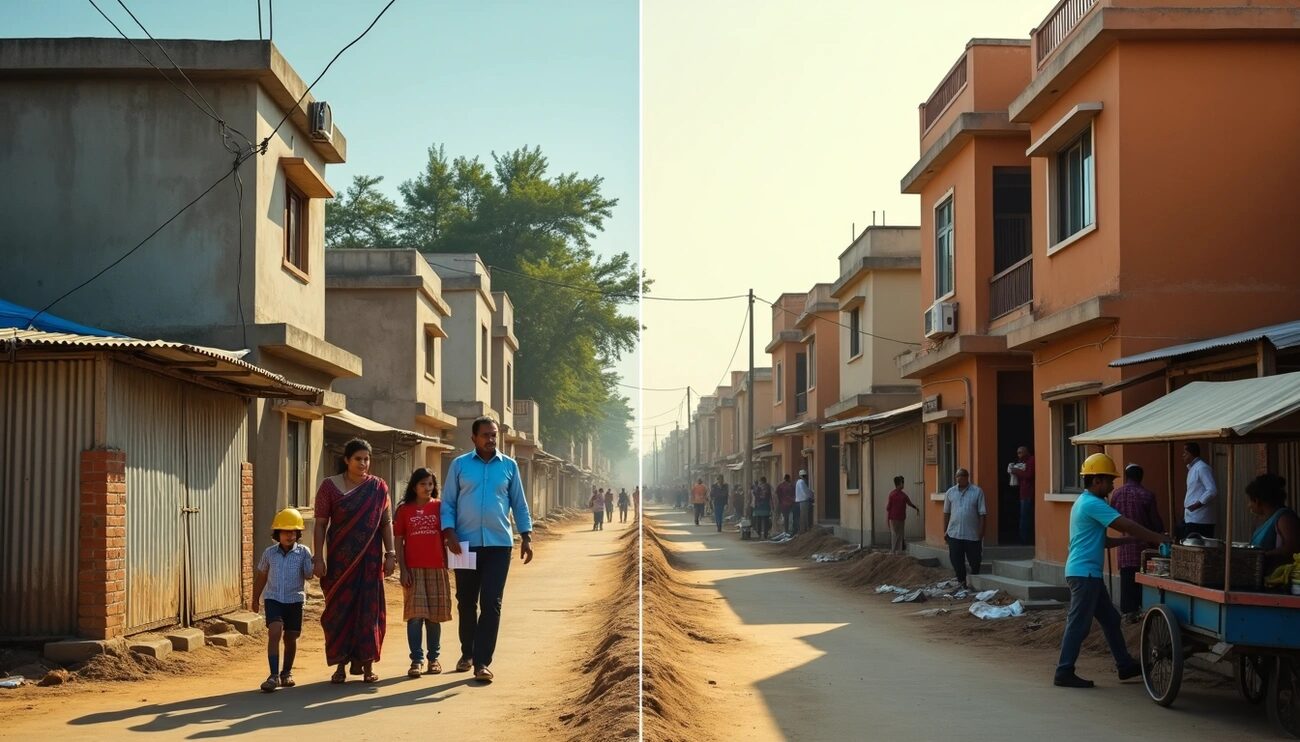
Updated on September 25, 2025
Want affordable housing? Looking for job training? Need better living conditions? This guide covers 12 essential government schemes for the urban poor in 2025 that could change your life. From Pradhan Mantri Awas Yojana to livelihood missions, these programs offer practical solutions to real problems.
Struggling to pay rent? Finding it hard to get clean water or proper toilets in your neighbourhood? You’re not alone.
India faces a massive urban housing shortage of 19 million homes, most affecting families with limited income. The situation gets more urgent each year – according to UN-HABITAT, about 675 million Indians (43%) will live in urban areas by 2035.
But here’s the good news: the government has created several schemes specifically for people like you. These programs provide genuine assistance with housing, employment, and essential services.
The results speak for themselves:
- 13+ lakh urban poor received skill training since 2014
- 6.78+ lakh people placed in jobs through these programs
- 7.8+ lakh beneficiaries got loans with interest subsidies for starting small businesses
- 38+ lakh loans worth Rs. 4405 crore helped street vendors under PM SVANidhi alone
Pro-tip: Most schemes reserve spots for SC/ST, women, persons with disabilities, and minorities. If you belong to these groups, mention it when applying to improve your chances!
Let’s discover which schemes can help you the most!
1. Pradhan Mantri Awas Yojana – Urban (PMAY-U)
Need an affordable house in the city? PMAY-U might be your answer. Launched on June 25, 2015, this flagship housing scheme is helping millions of urban families get proper homes. From slum dwellers to low-income workers, PMAY-U creates pathways to stable, quality housing.
What does PMAY-U aim to achieve?
PMAY-U focuses on providing “Housing for All” through all-weather pucca houses for eligible urban families. Though initially set to end in 2022, the government extended the mission until December 31, 2025, making sure all approved houses get completed.
The scheme targets those who need it most – slum dwellers and economically disadvantaged urban residents currently living in inadequate housing. With PMAY-U 2.0 launched in September 2024, the government plans to build 1 crore new houses over five years.
How can PMAY-U help you?
The scheme offers four different ways to get housing support:
- Beneficiary-led Construction: Get ₹1.5 lakh to build a new home or improve your existing one if you’re from an EWS family
- Affordable Housing in Partnership: Receive ₹1.5 lakh for an EWS house in projects where at least 35% of houses are for the EWS category and projects have a minimum of 250 houses
- In-situ Slum Redevelopment: Qualify for ₹1 lakh assistance if you’re a slum dweller, with land used as a resource and private developers participating
- Credit Linked Subsidy: Save money through interest subsidies of 6.5% (EWS/LIG), 4% (MIG-I), and 3% (MIG-II) on housing loans
Women’s empowerment is built into the scheme – houses must be registered in a woman’s name or jointly with male family members.
Are you eligible for PMAY-U benefits?
Your eligibility depends on your family’s annual income:
- EWS: Earning up to ₹3 lakh per year
- LIG: Earning between ₹3-6 lakh per year
- MIG: Earning between ₹6-9 lakh per year (in PMAY-U 2.0)
Important: You shouldn’t already own a pucca house anywhere in India. The scheme gives preference to widows, single women, persons with disabilities, senior citizens, transgender individuals, SC/ST/OBCs, and minorities.
Applying is hassle-free through the official PMAY-U portal or your local Urban Local Body office.
PMAY-U success so far
The numbers show PMAY-U’s massive impact: 118.64 lakh houses approved and more than 88.02 lakh already completed and handed over to families. The mission began by covering 4,041 statutory towns, focusing first on 500 Class I cities. Now, PMAY-U 2.0 aims to help an additional 1 crore urban families get proper housing over the next five years.
2. Deendayal Antyodaya Yojana – National Urban Livelihoods Mission (DAY-NULM)
Got a house but no steady income? DAY-NULM helps urban poor families earn a living through skills training and self-employment support. Launched in 2014, this mission tackles the root causes of urban poverty with practical solutions.
What DAY-NULM aims to do
This mission believes every poor person has entrepreneurial potential waiting to be unlocked. Its main goal? Reduce urban poverty by creating pathways to reliable income through self-employment and skilled jobs. Beyond this, DAY-NULM provides shelters for homeless people and helps street vendors find proper spaces to run their businesses.
How DAY-NULM helps you
The scheme offers several direct benefits that can change your financial situation:
- Loans for your business: Get up to ₹2 lakh for individual businesses and ₹10 lakh for group enterprises with affordable 7% interest rates
- Support through Self-Help Groups: Join or form an SHG and receive ₹10,000 as a starting fund; Area Level Federations get ₹50,000
- Extra benefits for women: Women’s SHGs get an additional 3% interest reduction when they repay loans on time
- 24×7 shelters for the homeless: Access permanent shelters with kitchens, water, toilets and electricity if you need housing
- Help for street vendors: Get ID cards, designated spaces, loans, and skills training to improve your vending business
Who can apply for DAY-NULM
If you live in an urban area and fall below the poverty line as defined by your state, you qualify. The scheme gives special attention to SC/ST communities, women, minorities, and persons with disabilities—up to 25% of beneficiaries come from these groups. The mission works in all district headquarters and cities with over 1 lakh people as per the 2011 census.
DAY-NULM’s achievements so far
The numbers show DAY-NULM is making a real impact:
- 10+ lakh Self-Help Groups formed (6.79 lakh got revolving funds)
- 15.42+ lakh people trained in various skills
- 8.43+ lakh secured job placements
- 9.82+ lakh people received help to start micro-enterprises
- 6.42+ lakh loans given to Self-Help Groups
- 32.59+ lakh street vendors got ID cards
- 1,995 shelters now operating for homeless urban residents
The government has put its money where its mouth is—releasing ₹5,508.87 crore for this mission, with ₹5,390.42 crore already used effectively across states and UTs.
Raj’s tip: For fastest approval, join an existing Self-Help Group in your area before applying for benefits. Group applications typically process quickly than individual ones.
3. PM Street Vendor’s AtmaNirbhar Nidhi (PM SVANidhi)
Are you a street vendor struggling to restart your business after COVID-19? PM SVANidhi offers you a financial lifeline with hassle-free loans!
Launched on June 1, 2020, this scheme helps street vendors like you get back on your feet with working capital loans. It’s not just about money – it’s about bringing you into the formal banking system and building your credit history.
What can PM SVANidhi do for you?
The scheme grows with your business through a step-by-step approach:
- Get loans without collateral: Start with ₹10,000, then qualify for ₹20,000, and finally up to ₹50,000 as you repay on time
- Save on interest: Enjoy a 7% interest subsidy when you repay on time
- Earn extra through digital payments: Receive up to ₹1,200 yearly cashback for using digital transactions
- Go digital easily: Free BHIM UPI QR code and training for hassle-free cashless sales
Plus, you get an official ID card giving you formal recognition as a vendor!
Who can apply and how?
If you were selling on urban streets as of March 24, 2020 – whether you sell vegetables, clothes, food, or any other items – you qualify!
Applying is simple:
- Online through the PM SVANidhi portal or mobile app
- Visit your nearest Common Service Center
- Apply at your Municipal office
- Through banks, including commercial banks, RRBs, and small finance banks
Just gather your vending certificate/ID from Urban Local Bodies, a recommendation letter, and proof that you’re a vendor.
Success so far
The numbers speak for themselves! As of April 2024:
- 38+ lakh loans worth ₹4,405 crore disbursed
- Digital transactions exceeding ₹35 crore
- Vendors received over ₹112 crore in interest subsidies
- Impressive 89% repayment rate
The scheme now operates across 4,709 Urban Local Bodies nationwide with around 2,000 lending institutions on board.
Want to boost your street vending business? PM SVANidhi could be your stepping stone to financial stability!
4. Swachh Bharat Mission – Urban (SBM-U)
Tired of dirty surroundings and a lack of proper toilets in your neighbourhood? Swachh Bharat Mission-Urban (SBM-U) might be your answer. Launched on October 2, 2014 (Mahatma Gandhi’s birth anniversary), this program aims to make urban India clean and open-defecation-free.
What does SBM-U want to achieve?
The mission has three main goals:
- End open defecation in all urban towns
- Ensure scientific management of all city waste
- Create lasting behaviour change through public participation (Jan Andolan)
SBM-U 2.0, launched after the first phase ended in 2021, now also focuses on making cities “garbage-free” with 100% door-to-door collection of separated waste. For smaller cities (below one lakh population), a major goal is preventing untreated toilet waste from polluting the environment.
How does SBM-U help the urban poor?
If you’re from an economically weaker section, here’s what SBM-U offers you:
- Toilet in your home: The mission has built over 62.79 lakh individual household toilets, exceeding its target of 58.99 lakh
- Public toilet access: Community and public toilets built with special features for women, children, and persons with disabilities
- Better health: Cleaner surroundings and proper waste management mean fewer diseases in crowded areas
- Money for building toilets: Get Rs. 16,000 to Rs. 20,000 in states (with 25% state contribution) or Rs. 5,333 in Union Territories
Who can benefit from SBM-U?
The scheme focuses on:
- Households without toilets that practice open defecation
- Families with unsafe toilets that need conversion to sanitary ones
- Priority for vulnerable groups like pensioners, girl children, and pregnant/nursing women
Your local Urban Local Body (ULB) determines exactly who gets benefits in your area. You can choose from different toilet options – twin pit, septic tank, bio-digester, or other safe options that suit your local conditions.
Want to check if you qualify? Visit your nearest municipal office or contact a local Swachhata ambassador. You might be just one application away from a cleaner, healthier home!
5. Atal Mission for Rejuvenation and Urban Transformation (AMRUT)
Ever turned on the tap and found no water? Or walked through waterlogged streets after rain? These basic infrastructure problems affect millions of urban poor daily.
AMRUT tackles these exact issues head-on. Launched on June 25, 2015, this mission builds essential infrastructure that makes everyday life better, especially for families in low-income areas.
What does AMRUT aim to do?
AMRUT has three simple goals:
- Get a working water tap and sewerage connection to every home
- Create clean, green spaces where you can relax and breathe fresh air
- Reduce pollution with better transport options
The mission started with 500 selected cities and towns across India. After seeing good results, the government launched AMRUT 2.0 on October 1, 2021. This newer version focuses on making cities “water secure” with universal water supply coverage and better sewage management. It also promotes water conservation, cleaning up water bodies, and reusing treated wastewater.
How AMRUT helps the urban poor
If you live in a low-income urban area, AMRUT brings real improvements to your daily life:
- Clean water at home: Aims to provide 135 litres of water per person daily with direct connections to every household
- Better sanitation: Complete coverage of toilets (individual or community) and sewerage networks that work
- Protection from flooding: Improved stormwater drainage to prevent waterlogging during monsoons
- Green spaces to enjoy: 10-12 square meters of open space per person in plain areas – parks where your children can play
So far, AMRUT has connected over 134 lakh homes to water taps and 102 lakh homes to sewer lines across India.
Who benefits from AMRUT?
Unlike schemes where you need to apply individually, AMRUT improves infrastructure for everyone in the selected cities. The mission covers:
- Cities with over 1 lakh population and notified municipalities
- All state/UT capitals
- Heritage cities under the HRIDAY scheme
- 13 cities on main rivers with populations between 75,000-1 lakh
- 10 cities from hill states, islands, and tourist destinations
AMRUT 2.0 has a total budget of ₹2,99,000 crore, with central assistance of ₹76,760 crore over five years. Implementation happens through State Annual Action Plans created by each state and union territory.
Pro-tip: Contact your local Urban Local Body (ULB) office to find out which AMRUT projects are underway in your area and when your neighbourhood will benefit.
6. Rajiv Awas Yojana (RAY)
Living in a slum with no legal rights to your home? RAY was created just for you.
Launched in June 2011, Rajiv Awas Yojana aims to create a “Slum Free India” by bringing slum areas into the formal housing system. The scheme helps transform existing slums into proper neighbourhoods with all the basic services that other city residents enjoy.
What makes RAY different?
RAY tackles three big problems at once:
- Brings unofficial slums into the formal system
- Fixes issues that led to slum formation in the first place
- Creates new affordable housing where it’s most needed
The government rolled out RAY in two phases – a preparation phase until June 2013, followed by implementation from 2013-2022. The goal? Transform slums completely, not just patch up problems.
How RAY helps slum dwellers
If you live in a slum area, RAY offers real benefits:
- Turn kutcha into pucca: Get help upgrading your existing home into a permanent structure
- Get basic services: Access clean drinking water, proper roads, streetlights, and sewerage
- Financial support: Easier access to small loans from nationalized banks
- Community power: Join slum dwellers’ associations that give you a stronger voice
Can you benefit from RAY?
RAY covers all types of slums across India:
- Slums on government land (central or state)
- Slums on private land
- “Urbanized villages” inside city areas
- Spaces used by homeless people and pavement dwellers
Priority goes to cities with more slum dwellers, district headquarters, and areas with religious or cultural importance. Cities with large SC/ST/minority populations also get special attention.
Projects typically cover at least 250 homes, with funding based on city size.
Aarav’s Tip: If you live in a slum area and want to know if RAY applies to your locality, visit your nearest Urban Local Body (ULB) office. They can tell you if your area is included in any ongoing RAY projects.
7. Basic Services to the Urban Poor (BSUP)
Need more than just a house? What about water, toilets, and community spaces? BSUP helps with all these basics in one go.
Started in 2005 as part of the Jawaharlal Nehru National Urban Renewal Mission, BSUP takes a “fix everything together” approach to slum improvement. Instead of solving one problem at a time, it tackles multiple issues simultaneously.
What BSUP aims to do
The scheme focuses on giving urban poor communities complete access to basic services:
- Bringing proper services to poor families in selected cities
- Giving slum dwellers secure housing they can afford
- Making sure new facilities stay maintained and usable
- Filling the gaps in basic services that many settlements lack
- Making civic amenities available to everyone
BSUP creates what officials call a “garland of seven entitlements” – secure housing, affordable homes, water, sanitation, health, education, and social security, all bundled together.
How BSUP helps you
If you live in a low-income urban area, here’s what BSUP offers:
- Complete development: Fixes homes while also adding infrastructure around them
- Necessities: Bring a water supply, sewerage, drainage, community toilets, and garbage collection
- Affordable homes: Build houses that slum dwellers and low-income families can afford
- Community spaces: Creates community halls, child care centers, and other shared facilities
- Cleaner surroundings: Improves drainage and manages waste to make neighbourhoods healthier
One key advantage? BSUP insists that “urban poor are provided housing near their place of work” – so you don’t lose your livelihood when improving your living conditions.
Who can benefit from BSUP?
The scheme started in selected cities based on population:
- 7 cities with more than 4 million people
- 28 cities with 1-4 million people
- 28 cities are important for religious, historical, or tourist reasons
To make sure you have a stake in your new home, you’ll need to contribute a small amount – 12% of housing costs for the general category and 10% for SC/ST/BC/OBC/PH and other vulnerable groups.
The funding comes through the central government, state governments, and urban local bodies working together. Once your city signs the agreement, the first 25% of funds gets released right away to start improvements.
Pro-tip: Contact your local Urban Local Body (ULB) office to check if your area is covered under BSUP and how to apply for benefits!
8. Integrated Housing and Slum Development Program (IHSDP)
Need better housing in a smaller city? IHSDP could be your answer.
This program combines earlier schemes (VAMBAY and NSDP) into one powerful package for urban poor living in smaller towns and cities. If you live outside the big metro areas covered by other missions, IHSDP is designed specifically with you in mind.
What IHSDP does for you
IHSDP doesn’t just build houses – it creates entire living environments with everything you need:
- Housing assistance worth Rs. 1,00,000 per dwelling unit (increased from the original Rs. 80,000)
- Decent living space of at least 25 sq. meters, usually with two rooms plus a kitchen and a toilet
- Women’s empowerment through land titles, preferably in the wife’s name or jointly with the husband
- Strong financial backing with an 80:20 funding split between Central Government and State/ULB (90:10 for special category states)
- Complete infrastructure, including water supply, sewerage, storm drains, community baths, street lights, and community toilets
The program works to develop slum areas holistically, creating healthy living environments rather than just putting up walls and roofs.
Who can apply?
You qualify for IHSDP if you:
- Live in any city or town as per the 2001 Census (except those already covered under JNNURM)
- Are a slum dweller (the program uses a cluster approach to help entire communities)
You’ll need to contribute a small amount – 12% of housing costs for general categories and 10% for SC/ST/BC/OBC/PH and other vulnerable sections.
Aarav’s Tip: Mizoram was named ‘Best Performing State during 2007-2012’ for its IHSDP implementation. See if your state has similar success stories that might help guide your application process!
The money flows directly from the Central Government as Additional Central Assistance, with the first 25% released when your state signs the agreement. Check with your local municipal office to find out how to apply in your area.
9 Interest Subsidy Scheme for Housing the Urban Poor (ISHUP)
Dreaming of your own home but scared of high loan interest rates? ISHUP was designed to make that dream more affordable. This government scheme helped lower-income families by cutting interest rates on housing loans, making monthly payments manageable for those with limited incomes.
What ISHUP aimed to do
ISHUP focused on providing interest subsidies to families who needed it most – those in Economically Weaker Sections (EWS) and Low Income Groups (LIG). The scheme encouraged poor families to take loans from banks and HUDCO at much lower interest rates. Over its 4-year run (2008-12), it aimed to help create 3.10 lakh new houses, working toward the bigger goal of “Affordable Housing For All.”
How ISHUP helped the urban poor
The scheme offered several money-saving benefits:
- Big interest savings: 5% interest subsidy on housing loans up to ₹1 lakh for the entire loan period
- Longer repayment time: 15-20 years to repay, making monthly installments smaller
- Upfront benefits: Interest subsidy given as Net Present Value, with each beneficiary saving over ₹30,000
- Flexible repayment: No penalties for paying your loan early
- No extra guarantees needed: No collateral or third-party guarantee required for loans up to ₹1 lakh
By March 2012, 10,215 families had already benefited, with ₹9.2 crore in subsidies released.
Who could apply for ISHUP?
ISHUP was designed for:
- EWS families: Monthly income below ₹5,000
- LIG families: Monthly income between ₹5,001-₹10,000
- Specific house sizes: At least 25 sq meters for EWS and 40 sq meters for LIG homes
- First-time homeowners: Applicants shouldn’t already own a house in their name, spouse’s name, or dependent children’s names
Priority was given to SC/ST families, minorities, persons with disabilities, and women, based on their proportion in the local population.
Though ISHUP ended on September 30, 2013, its core ideas live on in the Credit-Linked Subsidy Scheme under PMAY-Urban. If you’re looking for similar benefits today, check out PMAY-U’s CLSS component.
Aarav’s Pro-tip: While ISHUP itself isn’t available anymore, its successor schemes offer similar benefits with even better terms. Visit your nearest bank to learn about current housing loan subsidies under PMAY-U.
10. Smart Cities Mission
Living in a city that just doesn’t work for you? Imagine having clean water, reliable electricity, good transport, and affordable housing – all within reach. That’s exactly what the Smart Cities Mission aims to create.
Launched by PM Modi on June 25, 2015, this mission isn’t just about fancy technology – it’s about making life better for everyday citizens like you. The program targets 100 cities across India, focusing on areas where improvements make the biggest difference in people’s daily lives.
What does the Smart Cities Mission do?
The mission works through four main areas:
- Social Infrastructure (schools, hospitals, community spaces)
- Physical Infrastructure (water, electricity, roads)
- Governance (making city services more responsive)
- Economic Infrastructure (creating jobs and opportunities)
You, the citizen, stay at the center of all planning. The mission uses three main approaches:
- Retrofitting existing areas (improving what’s already there)
- Redeveloping rundown areas completely
- Creating new greenfield developments
How does this help if you’re from a low-income area?
If you live in a slum or low-income neighbourhood, this mission directly improves your daily life through:
- Better basic services: Clean water, reliable electricity, and proper toilets right where you live
- Affordable housing: The mission specifically focuses on creating housing options for the urban poor
- Improved transportation: Easier and cheaper ways to get to work, school, or the market
- Safer communities: Better street lighting and public spaces
- New job opportunities: As areas develop, more jobs become available locally
What’s been accomplished so far?
The results show real progress:
- 7,188 projects worth ₹1,44,237 crore have already been completed (90% of the planned work)
- 830 more projects worth ₹19,926 crore in the final stages
- 93% of the released ₹46,585 crore has already been put to use
- Mission extended until March 31, 2025, to complete all remaining projects
Want to know if your city is included? Check the official Smart Cities Mission website or contact your local municipal office. The transformation might already be happening in your neighbourhood!
Pro tip: If your area is part of a Smart City, attend community meetings about upcoming projects – your input can help shape developments in your neighbourhood.
11. National Slum Development Program (NSDP)
Need to understand where urban housing programs started? NSDP laid the foundation back in 1996.
This early initiative set aside Rs. 300 crore yearly to improve slum conditions across India. The program tried to solve multiple problems at once, from poor housing to a lack of basic services in slum areas.
What the NSDP aimed to do
NSDP focused on developing slum areas under Urban Local Bodies by providing essential services. The scheme covered both official (notified) and unofficial (non-notified) slums.
Money was distributed based on how many slum dwellers lived in each state, making funds available to all states and Union Territories.
The program became more urgent as India’s slum population exploded from 27.9 million in 1981 to a staggering 61.8 million by 2001. Official counts showed 52.4 million people living in slums across 1,743 cities and towns.
How NSDP helped the urban poor
The scheme provided several key benefits:
- Basic infrastructure: Water supply, drainage systems, and community baths
- Community facilities: Educational centers and health facilities
- Housing improvements: Both the repair of existing homes and the construction of new ones
- Financial structure: 70% loan and 30% grant format to encourage sustainability
Despite these efforts, NSDP had limitations. It only reached about 2,401 slums – roughly 50% of all settlements. The investment worked out to just Rs. 580 per slum dweller over eight years, far too little to keep pace with rapid urban growth.
In December 2005, NSDP merged into the Integrated Housing and Slum Development Program when the Jawaharlal Nehru National Urban Renewal Mission was launched. This change represented a shift toward more complete approaches to fighting urban poverty.
Aarav’s Tip: While NSDP has been replaced by newer schemes, understanding its approach helps you appreciate how current programs have evolved to offer better benefits. Modern schemes like PMAY-U provide much more substantial financial assistance.
12. Valmiki Ambedkar Awas Yojana (VAMBAY)
Need decent housing, but living in urban slums? VAMBAY might be what you’re looking for!
Announced during the Prime Minister’s Independence Day speech on August 15, 2001, VAMBAY was one of the first major schemes to tackle slum housing problems. The government committed serious money to this initiative – Rs. 1000 crores in subsidies plus another Rs. 1000 crores in HUDCO loans to build 4 lakh homes each year.
What does VAMBAY do for you?
VAMBAY focuses on three simple goals:
- Providing new homes or upgrading existing ones for urban slum dwellers below the poverty line
- Creating healthier neighbourhoods that help people escape poverty
- Working toward the big dream of “slumless cities” across India
What makes VAMBAY special is its focus on both housing AND sanitation. The scheme set aside 20% of funds (about Rs. 200 crores) specifically for community toilets through its Nirmal Bharat Abhiyan component, addressing a critical need in crowded urban areas.
How VAMBAY helps slum dwellers
The benefits are practical and tailored to different city sizes:
- Location-based funding: Rs. 60,000 for megacities, Rs. 50,000 for metro cities, and Rs. 40,000 for other urban areas.
- Shared costs: 50% from the central government, 50% from the state government.
- Decent living space: Minimum 15 square meters with sanitary toilets.
- Housing options: Both row houses and flats are available.
The scheme makes special efforts to help vulnerable groups:
- 50% of homes are reserved for SC/ST populations
- 30% for backward classes
- 15% for other weaker sections
- 5% for physically and mentally disabled persons
VAMBAY also promotes women’s empowerment by putting house ownership in women’s names or jointly with male family members.
Though VAMBAY was later merged into Jnnurm (with 1,748 units transferred to the new program), it laid important groundwork for future urban housing initiatives.
Pro tip: Even though this scheme has evolved, understanding its framework helps you navigate newer housing programs that follow similar principles!
Need help finding the right scheme? Look at your most urgent need first – housing, job training, or basic services – then check which scheme offers benefits that match your situation.
Top 12 Indian Government Schemes for Urban Poor
Below are the top 12 Indian government schemes for the urban poor.
| Scheme Name | Launch Year | Primary Objectives | Target Beneficiaries | Implementation Status |
|---|---|---|---|---|
| PMAY-U | 2015 | Providing “Housing for All” through pucca houses | – EWS (up to ₹3L/year) – LIG (₹3-6L/year) – MIG (₹6-9L/year) | 118.64 lakh houses sanctioned, 88.02 lakh completed |
| DAY-NULM | 2014 | Reduce urban poverty through self-employment and skilled wage opportunities | Formalize the street vending sector through micro-credit | – 10L Self-Help Groups formed – 15.42L candidates trained – 8.43L job placements |
| PM SVANidhi | 2020 | Integrated development of basic services for the urban poor | Street vendors operating in urban areas | Over 38L loans worth ₹4,405 crore disbursed |
| SBM-U | 2014 | Eliminate open defecation and ensure scientific waste management | Urban households practicing open defecation | 62,79,304 Individual Household Latrines completed |
| AMRUT | 2015 | Universal coverage of water supply and sewerage | 500 selected cities and towns | 134L water tap connections and 102L sewer connections |
| RAY | 2011 | Creating inclusive cities and addressing slum development | All slum dwellers in cities | Not mentioned |
| BSUP | 2005 | Below the poverty line urban slum dwellers | Selected cities based on population | Not mentioned |
| IHSDP | Not mentioned | Holistic slum development | Cities/towns not covered under JNNURM | Not mentioned |
| ISHUP | 2008 | Provide interest subsidies on housing loans | EWS (below ₹5,000/month) LIG (₹5,001-10,000/month) | 10,215 beneficiaries covered by March 2012 |
| Smart Cities Mission | 2015 | Improve quality of life through technology and planning | 100 selected cities | 90% of projects (7,188) worth ₹1.44L crore completed |
| NSDP | 1996 | Comprehensive development of slum areas | Urban slum populations | Covered 2,401 slums |
| VAMBAY | 2001 | Provide shelter for urban slum dwellers | Below the poverty line, urban slum dwellers | 1,748 units transferred to JnNURM |
Conclusion
The government has created real solutions for urban poor families. Each tackles a specific problem – from housing shortages to lack of clean toilets to limited job opportunities.
The numbers tell a powerful story:
- PMAY-U has helped build over 88 lakh houses
- DAY-NULM has trained more than 15 lakh people, with 8.43 lakh getting jobs
- PM SVANidhi has given 38+ lakh loans worth ₹4,405 crore to street vendors
But how do you know which scheme is right for you?
Most programs focus on helping specific groups – people with very low incomes (EWS), scheduled castes/tribes, women-headed households, and persons with disabilities. To apply, you’ll typically need:
- Income certificates
- Residence proof
- Category certificates (if applicable)
Pro tip: Your local Urban Local Body (ULB) office or nearest Common Service Center should be your first stop. These officials can guide you through the application process for most schemes.
Challenges still exist, of course. Cities are growing faster than housing in many places. But staying informed about these schemes is your best strategy for accessing benefits that could change your family’s life.
Remember, these programs work best when citizens actively participate. The government provides the framework, but your awareness and engagement determine how effective these schemes are in your community.
Want to improve your housing situation? Need clean water? Looking for job training? These 12 schemes offer real pathways to a better life in urban India. Take the first step today!
FAQs
Q1. What are some key government schemes for the urban poor in India?
Some important schemes include Pradhan Mantri Awas Yojana – Urban (PMAY-U) for affordable housing, Deendayal Antyodaya Yojana – National Urban Livelihoods Mission (DAY-NULM) for skill development and employment, and PM Street Vendor’s AtmaNirbhar Nidhi (PM SVANidhi) for providing micro-credit to street vendors.
Q2. How does the Pradhan Mantri Awas Yojana – Urban (PMAY-U) benefit low-income families?
PMAY-U provides central assistance of ₹1.5 lakh for the construction of new homes or the enhancement of existing ones.
It also offers interest subsidies on housing loans ranging from 3% to 6.5% for different income categories. The scheme mandates female ownership to promote women’s empowerment.
Q3. What support does PM SVANidhi offer to street vendors?
PM SVANidhi provides collateral-free working capital loans of ₹10,000 initially, which can increase to ₹20,000 and ₹50,000 in subsequent tranches. It offers a 7% interest subsidy on timely repayment and cashback incentives for digital transactions. The scheme also helps vendors build their credit profiles for future financial inclusion.
Q4. How does the Smart Cities Mission impact urban poor communities?
The Smart Cities Mission aims to improve the quality of life in 100 selected cities through technology and innovative planning. It focuses on developing both physical and social infrastructure, including affordable housing, efficient public transport, and water supply.
The mission has completed over 7,000 projects worth ₹1.44 lakh crore, benefiting urban residents, including low-income communities.
Q5. What are the eligibility criteria for most urban poverty alleviation schemes?
Most schemes target Economically Weaker Sections (EWS) with annual household incomes up to ₹3 lakh and Low Income Groups (LIG) with incomes between ₹3-6 lakh.
Many programs prioritize marginalized groups like Scheduled Castes, Scheduled Tribes, women-headed households, and persons with disabilities. Specific eligibility may vary by scheme, but it generally focuses on urban residents below the poverty line.
📩 If you notice any incorrect data in this guide or wish to share additional information, please write to us at info@indiansouls.in.
Over 2000+ Government Schemes & Policies Simplified
Indian Souls is your guide to government Schemes, scholarships, pensions, subsidies, job exams, and more. We break complex schemes into easy steps, helping every citizen take full advantage of the opportunities available.
No jargon. No confusion. Just useful info that helps indian citizen.
![12 Government Schemes for Urban Poor Must Know About [2025 Guide]](https://secure.gravatar.com/avatar/5638537e5b344b7cbe1439d78cb934214d53fc92ac65857e02464f537dfda7dd?s=200&d=monsterid&r=g "12 Government Schemes for Urban Poor Must Know About [2025 Guide] - Indian Souls")

 Rajesh Tanwar










%20–%20A%20Complete%20Guide)


)
%202026)


%20–%202025%20Complete%20Guide:%20Latest%20Updates,%20How%20It%20Works%20&%20Who%20Qualifies)
,%20Eligibility%20&%20Status%20Check)


:%2010000%20Rs.%20Monthy%20Stipened)


