
 Sudhir Singh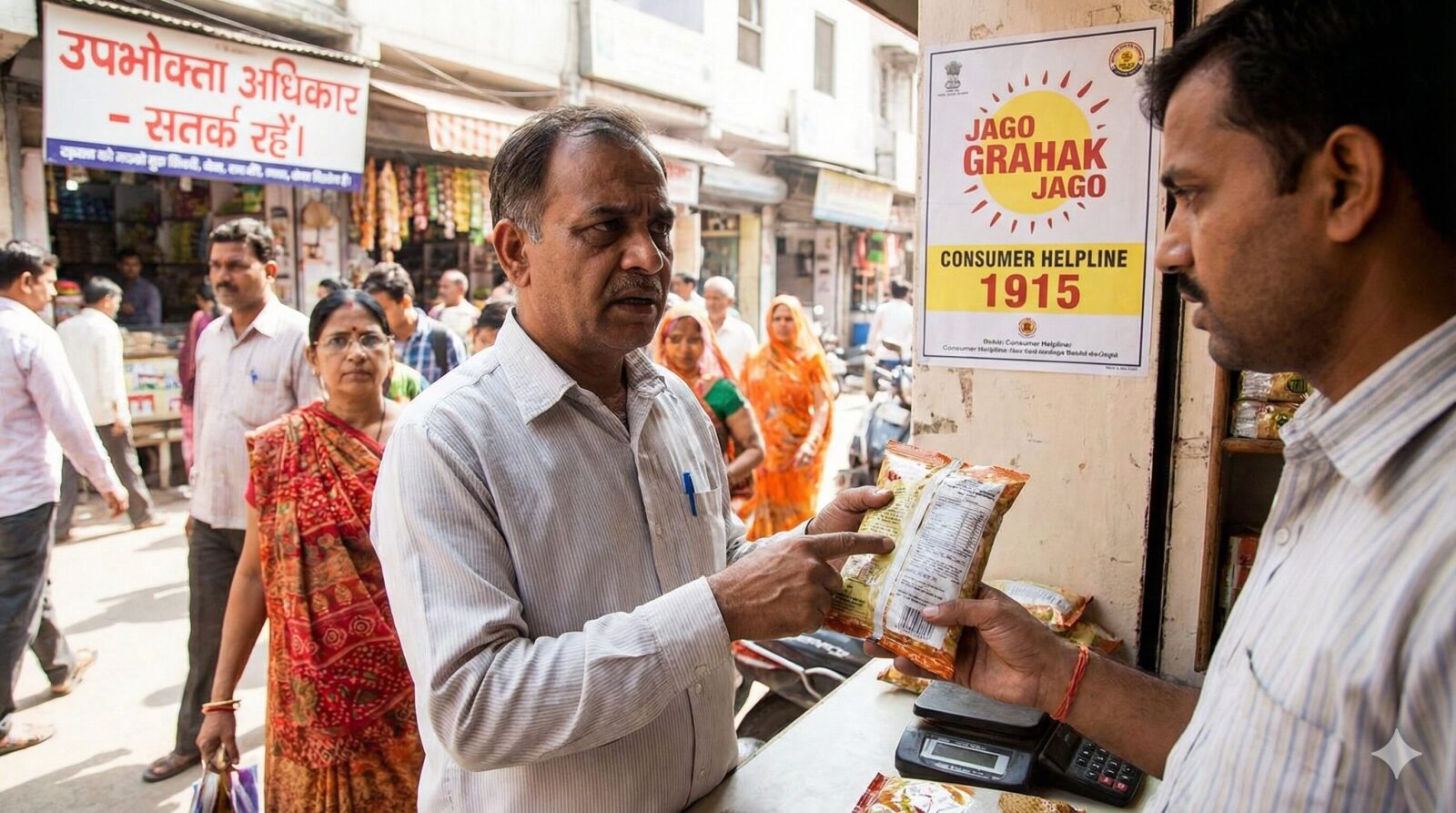
Updated on January 9, 2026
By: A Consumer Rights Concerned Citizen (20 Years of Experience Fighting for Rights)
Namaste friends.
My name does not matter. What matters is that I am just like you. I take the local train or bus to work. I bargain with the vegetable vendor for free dhaniya (coriander). I save money month by month to buy a fridge or a small gold chain for my daughter’s wedding.
For the last 20 years, I have seen how big companies, shopkeepers, and even doctors try to fool simple people like us. They think we are uneducated. They think we will not fight back. They think, “Chalta hai, India hai” (It happens, this is India).
But I am here to tell you that times have changed. You have power in your hands. Real power.
Just last month, my neighbour Sharma ji got a call. The caller said he is from the “Cyber Police” and that Sharma ji’s Aadhaar card was used for money laundering. They kept him on a video call for 6 hours! They called it “Digital Arrest.” Poor Sharma ji was so scared that he transferred ₹50,000 to them. It was a scam. If Sharma ji knew his rights, he would have known that the real police never ask for money online.
This article is not a boring law book. It is your weapon. I will explain everything I have learned in 20 years about how to save your hard-earned money and how to fight back when someone cheats you.
Part 1: The 6 Swords (Your 6 Rights)
The government passed a very strong law called the Consumer Protection Act (2019). Before this, there was an old 1986 law, but the new one is much better for us. It gives you 6 “Swords” or Rights. You must keep these sharp.
1. Right to Safety (Suraksha ka Adhikar)
This is the most important one. Anything you buy must not kill you or make you sick.
- What it means: If you buy a pressure cooker, it should not burst. If you buy an iron, it should not give you a shock. If you buy spices, they should not have sawdust mixed in them.
- Real Life Example: You buy a cheap extension cord from a local market. It melts and burns your TV. The shopkeeper says, “No guarantee on Chinese items.” He is wrong! Under this right, he cannot sell dangerous items.
- My Advice: Always check for marks. ISI Mark for electronics and cookers. FSSAI number for food items. Hallmark for gold. If these marks are missing, do not buy, even if it is ₹100 cheaper. Your life is worth more than ₹100.
2. Right to Information (Jaankari ka Adhikar)
The seller cannot hide things from you. You have the right to know everything about the product.
- What it means: You must know the Quality, Quantity, Purity, Standard, and Price.
- Real Life Example: You go to buy a packet of Namkeen. The shopkeeper gives you an old packet. You look at the back, and the “Expiry Date” is scratched off or covered with a new sticker. This is illegal. He is hiding information.
- My Advice: Before opening your wallet, turn the packet around. Read the ingredients. Read the “Best Before” date. If the writing is too small or hidden, put it back.
3. Right to Choose (Pasand ka Adhikar)
No one can force you to buy something you do not want.
- What it means: You have the freedom to select from different brands and prices.
- Real Life Example: This happens a lot with Gas Agencies. You go to get a new LPG connection. The manager says, “Sir, you must buy the gas stove from us only. Otherwise, we will not give you the cylinder.” This is 100% illegal. This is called “Restrictive Trade Practice.”
- My Advice: You can buy your stove from any shop you want. If the gas agency forces you, tell them you will complain to the District Supply Officer. Watch how quickly their tone changes.
4. Right to be Heard (Sunwai ka Adhikar)
If you have a problem, someone must listen to you.
- What it means: Companies cannot just take your money and disappear. They must have a customer care number or an office where you can complain.
- Real Life Example: You order a sari online. It comes torn. You call the customer care, but it is always busy, or an automated computer voice speaks. They are violating your right to be heard.
- My Advice: Always keep the bill and the complaint reference number. If they do not listen, the government forums will listen.
5. Right to Seek Redressal (Nivaaran ka Adhikar)
Listening is not enough. You need a solution.
- What it means: If you have been cheated, you deserve three things:
- Replacement of the bad product.
- Refund of your money.
- Compensation for the trouble (mental harassment).
- Real Life Example: You paid fees to a coaching centre. After 10 days, you realised the teacher is very bad. You want to leave. The centre says, “Fees are non-refundable.” The courts have said this is unfair. They have to return the balance of money.
6. Right to Consumer Education (Shiksha ka Adhikar)
You have the right to learn about these rights.
- What it means: That is exactly what you are doing right now by reading this article! The government runs the “Jago Grahak Jago” campaign for this reason. Ignorance is the biggest enemy.
Part 2: The Daily Scams (And How to Catch Them)
Now, let us talk about the real things happening in our markets. These are the tricks shopkeepers play on us every day.
Scam 1: The “Cooling Charge” on Water Bottles
It is a hot summer day in May. You are thirsty. You go to a shop and ask for a cold water bottle. The bottle says MRP ₹20. The shopkeeper asks for ₹25. You ask why? He says, “₹5 cooling charge, sir. Electricity is expensive.” The Truth: This is illegal. The Supreme Court has clearly said that a shopkeeper cannot charge even 1 paisa more than the Maximum Retail Price (MRP). The MRP includes the cost of cooling, transport, profit, tax, and everything. What to Do: politely tell him, “Bhaiya, MRP means Maximum. You cannot charge extra. If you want, I can dial 1915 right now.” Usually, they will take ₹20.
Scam 2: The Weighing Scale Trick (Dandi Maarna)
This is the oldest trick in the book.
- Vegetable Market: The vendor puts a magnet under the scale pan. Or he uses stones instead of proper iron weights.
- Sweet Shop: You ask for 1kg Kaju Katli. He puts the heavy cardboard box on the scale first, and then fills it with sweets. The box weighs 100 grams. You are paying the price of Kaju Katli (₹800/kg) for a cardboard box! You lose ₹80 immediately. What to Do:
- In sweet shops, ask them to weigh the sweets first on a piece of paper, and then put them in the box. Or ask them to set the machine to zero after putting the empty box.
- Look at the digital meter carefully. It must start at 0.000, not 0.050.
Scam 3: The LPG Cylinder Theft
The delivery boy brings your gas cylinder. He is in a rush. He keeps it down, takes cash, and leaves. You finish the cylinder in 20 days instead of 30 days. Why? Because he stole 2kg of gas from it. What to Do: Every gas delivery boy carries a spring balance (weighing scale). It is mandatory.
- Ask him to weigh the cylinder in front of you.
- Check the “Net Weight” written on the cylinder (usually 14.2 kg of gas).
- Check the “Tare Weight” written on the cylinder (empty cylinder weight, usually around 15-16 kg).
- Total weight should be Net + Tare (approx 29-30 kg). If it is 25 kg, do not take it!
Scam 4: The “Carry Bag” Charge
You go to a big mall or a brand showroom like Bata or Big Bazaar. You buy shoes for ₹2000. At the billing counter, they add ₹10 for a paper bag with their advertisement on it. The Truth: If the bag has the company’s logo or advertisement, they CANNOT charge you for it. They are making you pay to advertise their own brand! The courts have fined many big companies for this. What to Do: Tell them, “If you charge for the bag, give me a plain bag without your logo. If you give me the logo bag, it must be free.”
Part 3: The Big Sectors – Medical, Education, & Builders
Consumer rights are not just for small items like soap and oil. They are also for the big expenses in your life.
1. Medical Negligence (Doctors and Hospitals)
We treat doctors like Gods. But sometimes, they make mistakes.
- Example: A doctor operates on the wrong leg. Or a hospital charges you for 50 pairs of gloves when only 2 were used. Or they refuse to give you the medical file and reports when you get discharged.
- Your Right: You are a consumer of medical services. The hospital must give you an itemised bill (breakdown of every rupee). They cannot hold the dead body of a patient hostage for unpaid bills. That is a crime. If a doctor is careless and causes harm, you can sue them in the Consumer Court for compensation.
2. Education and Coaching Fees
In India, we spend our life savings on our children’s education.
- The Issue: You pay ₹1 Lakh for a year-long engineering entrance coaching. Your child gets sick or does not understand the classes and quits after 1 month. The institute says, “No Refund Policy.”
- The Law: The National Consumer Commission has ruled that educational institutions (especially private coaching centres) are service providers. They cannot charge fees for the time they did not teach. They must deduct the fee for 1 month and refund the rest.
3. Builder Delays
You booked a flat in 2018. The builder promised possession in 2021. It is now 2026, and the building is still half-done. You are paying rent AND home loan EMI.
- Your Right: You do not have to wait forever. You can go to the Consumer Commission. You can ask for a full refund with interest (usually 9% to 12%), or ask for immediate possession with a penalty payment for the delay. Do not be afraid of the builder’s big lawyers. The law is on your side.
Part 4: The Brahmastra – How to Fight Back
Okay, so you were cheated. You argued with the shopkeeper, but he laughed at you. What do you do now? Do not go to the police station. They will say,y “This is a civil matter,r” and send you away.
You have two easy ways to fight.
Method 1: The Call (Pre-Litigation)
This is for small issues.
- Step 1: Dial 1915. This is the National Consumer Helpline (NCH).
- Step 2: Speak to the agent. They speak Hindi, English, and many regional languages. Tell them your problem clearly.
- Step 3: They will give you a Complaint ID. They will send your complaint to the company.
- Step 4: You can also use the “NCH” App on your phone or WhatsApp on 8800001915.
- Result: Many big companies (Amazon, Flipkart, telecom companies, banks) are connected to this system. They usually solve the problem within a few days because they do not want the government to get angry.
Method 2: The E-Daakhil Portal (Filing a Formal Case)
If 1915 does not work, or if the amount is big (like a flat or car), you must file a case in the Consumer Commission. Earlier, you had to hire a lawyer and run to the court 10 times. Now, you can do it from your mobile phone, sitting at home.
The Golden Rule of Jurisdiction (Where to file): Since 2021, the money limits have changed. Remember this carefully:
- District Commission: If the value of goods/services paid is up to ₹50 Lakhs. (Most of our cases go here
- State Commission: If the value is between ₹50 Lakhs and ₹2 Crores.
- National Commission: If the value is more than ₹2 Crores.
Step-by-Step Guide to File Online (E-Daakhil):
- Go to the Website: Open
edaakhil.nic.in. - Register: You have to create an account. You will need your email ID and mobile number. Upload a copy of your ID proof (Aadhaar or Voter ID).
- Verify: They will send an OTP. Once verified, you can log in.
- Start New Case: Click on “File a New Complaint”
- Enter Details:
- Complainant: That is you. Fill yoin ur name and address.
- Opposite Party: That is the cheater. Fillin he shop/company name and address.
- Complaint Details: Write down what happened in simple English or Hindi. “I bought a TV on 1st Jan. It stopped working on 2nd Jan. The service centre refused to repair.”
- Upload Documents: This is very important. You must upload:
- Invoice/Bill: Proof that you bought it. (Kaccha bill is weak evidence, always ask for Pakka GST Bill).
- Proof of Defect: Photos of the broken item, or screenshots of emails/chats where they refused to help.
- Affidavit: A simple paper on which you swear that whatever you are saying is true.
- Pay Fee: For small cases (up to ₹5 Lakhs), there is usually NO FEE. It is free! For larger amounts, the fee is very small (like ₹200 or ₹500). You can pay online via UPI or Net Banking.
- Submit: Once you click submit, your case is filed. You will get a hearing date online.
Do I need a Lawyer? NO. The best part of the Consumer Court is that you can argue your own case. You can stand there and tell the Judge/President what happened. The judges in consumer courts are very helpful to common people. They understand that you are not a lawyer.
Part 5: Important Tips from My Experience
Over 20 years, I have realised that we lose cases because of our own small mistakes. Follow these rules:
1. The “Pakka Bill” Rule Shopkeepers will tell you, “Sir, if you take a bill, I have to charge 18% GST extra. Take it without a bill, save money.” DO NOT FALL FOR THIS. Without a bill, you have no proof. You cannot go to court. That 18% is the price of your safety. Always take a printed bill with the shop’s GST number on it.
2. Never sign “Received in Good Condition” Without Checkin.g When a delivery comes (fridge, sofa, washing machine), the delivery boy will ask you to sign a paper. That paper usually says in small letters: “I have received the item in good working condition.” If you sign it without opening the box, and later find a dent, the company will show your signature and say, “See? He said it was fine.” Tip: Always write “Subject to Verification” or “Box Not Opened” near your signature if they don’t let you open it first.
3. Record Videos When you open an expensive parcel from an online website, make a video on your phone. Show the label, show the seal being cut, and show the product coming out. If they send you a brick instead of a phone (it happens!), this video is your biggest proof.
4. The Notice Peri..od Before filing a court case, send a simple letter or email to the company. “You cheated me. If you don’t solve this in 15 days, I will go to court.” This is called a “Legal Notice” (though you can write it yourself). Many companies will solve the issue just to avothe id court.
Conclusion: Jago Grahak Jago
Friends, the government can make laws, but it cannot come to your house to check your milk packet. You have to do it.
When you fight for your ₹5 or ₹50, you are not being “cheap.” You are being a responsible citizen. When you complain about a shopkeeper who cheats, you are saving the next 100 people from being cheated by him.
The system has improved. The E-Daakhil portal is working. The 1915 helpline is working. The only thing missing is your action.
Next time someone tells you “No Refund,” look them in the eye and say, “That is against the Consumer Protection Act, 2019.”
Save these numbers now:
- Helpline: 1915
- WhatsApp: 8800001915
- Website: consumerhelpline.gov.in
Be smart. Be safe. Jai Hind.
📩 If you notice any incorrect data in this guide or wish to share additional information, please write to us at info@indiansouls.in.
Over 2000+ Government Schemes & Policies Simplified
Indian Souls is your guide to government Schemes, scholarships, pensions, subsidies, job exams, and more. We break complex schemes into easy steps, helping every citizen take full advantage of the opportunities available.
No jargon. No confusion. Just useful info that helps indian citizen.























 Rajesh Tanwar



![12 Government Schemes for Urban Poor Must Know About [2025 Guide]](https://indiansouls.in/wp-content/uploads/2025/05/image-1.jpg "Don’t Let Them Loot You! A Common Man’s Guide to Consumer Rights in India - Indian Souls")









%20–%20A%20Complete%20Guide)


)
%202026)


)

%20–%202025%20Complete%20Guide:%20Latest%20Updates,%20How%20It%20Works%20&%20Who%20Qualifies)
,%20Eligibility%20&%20Status%20Check)


:%2010000%20Rs.%20Monthy%20Stipened)
