
 Sudhir Singh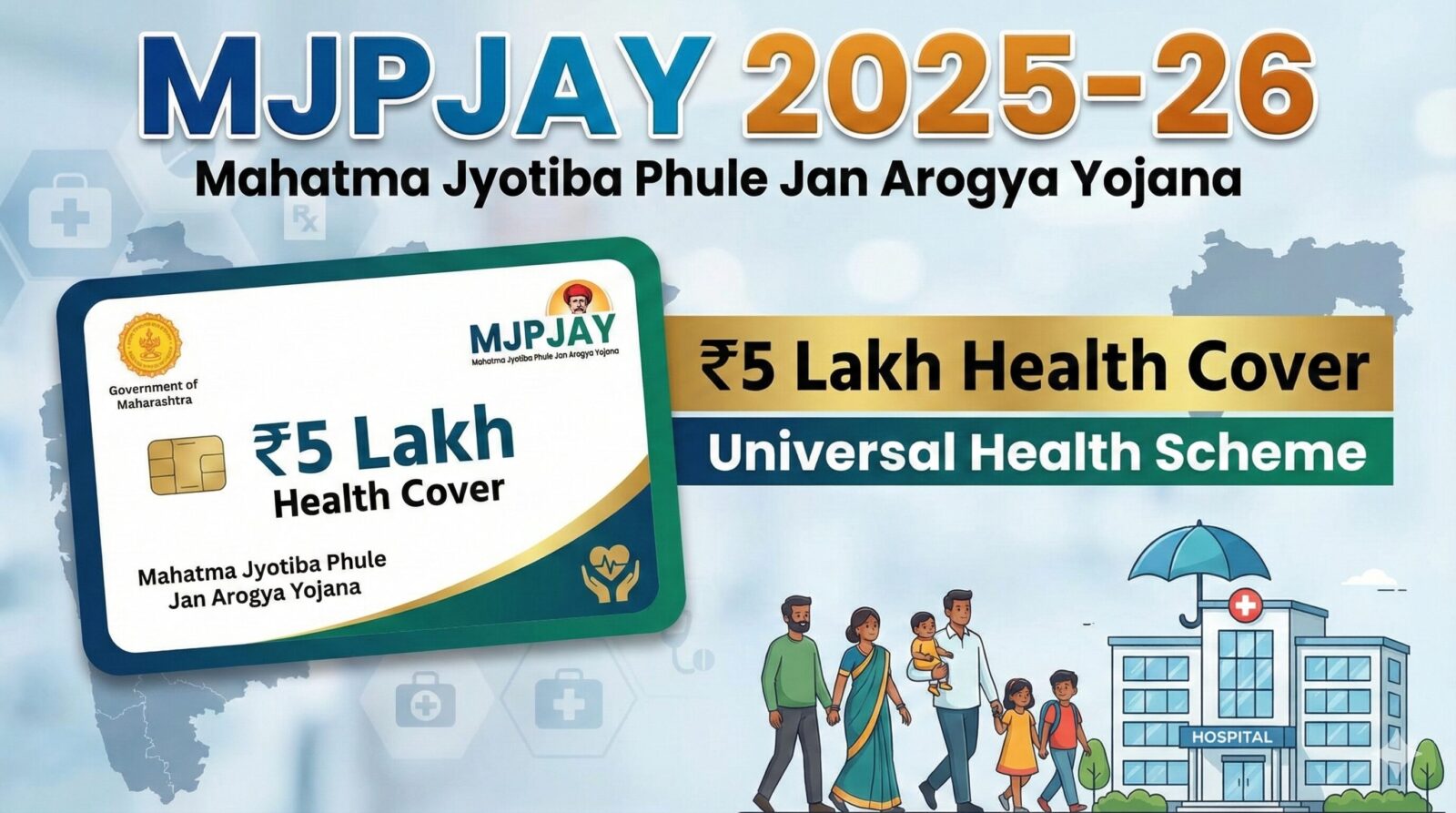
Updated on December 13, 2025
Medical emergencies don’t knock before entering. One day life is normal, and the next day, a doctor is asking for ₹2 Lakhs for a sudden heart surgery or knee replacement. For the average middle-class or lower-income family in Maharashtra, this used to mean taking loans, selling gold, or asking relatives for money.
But in 2025-26, the picture has changed.
The Government of Maharashtra has expanded its flagship health scheme, the Mahatma Jyotiba Phule Jan Arogya Yojana (MJPJAY). It is no longer just for the “poor.” It has become a Universal Health Scheme.
This means almost every resident of Maharashtra—whether you live in a hut or a flat, whether you have a yellow ration card or a white, is now covered for up to ₹5 Lakhs per year.
This guide covers everything you need to know: eligibility, how to apply, which hospitals to go to, and what documents to carry.
1. What is MJPJAY? (The Basics)
MJPJAY, formerly known as the Rajiv Gandhi Jeevandayee Arogya Yojana (RGJAY), is a health insurance scheme fully funded by the Government of Maharashtra.
In simple terms: The Government pays your hospital bill.
The Big Change in 2025 (Integration with PMJAY)
Recently, the state government combined MJPJAY with the central government’s Ayushman Bharat – Pradhan Mantri Jan Arogya Yojana (AB-PMJAY).
- Before: Two separate schemes with different limits.
- Now: A unified “Co-branded” card system.
- The Benefit: The insurance limit has been increased significantly, and the eligibility criteria have been relaxed to cover the entire population of the state.
2. MJPJAY Key Features & Highlights (2025)
Here is a quick snapshot of what the scheme offers today:
- Insurance Cover: ₹5,00,000 (5 Lakhs) per family per year.
- Basis: Family Floater. (This means the ₹5 Lakh can be used by one person entirely or split among multiple family members).
- Type of Treatment: Cashless. You do not pay first and claim later. The hospital settles the bill directly with the insurance company.
- Coverage: 1,356 Medical Procedures (Surgeries, Therapies, Critical Care).
- Pre-existing Diseases: Covered from Day 1. (Unlike private insurance, where you wait 3-4 years).
- Eligibility: Universal. (All valid Ration Card holders + Domicile holders).
3. MJPJAY Eligibility Criteria: Who Can Apply?
This is the most important section. The government has divided beneficiaries into categories based on their Ration Card and income status.
Category A: The Priority Group (PMJAY + MJPJAY)
These families were already covered under the old rules and continue to get benefits.
- Yellow Ration Card Holders: Families living below the Poverty Line (BPL).
- Antyodaya Anna Yojana (AAY) Card Holders: The poorest of the poor.
- Annapurna Ration Card Holders: Destitute senior citizens.
- Orange Ration Card Holders: Families with annual income usually between ₹1 Lakh and ₹59,000 (varies by district).
Category B: The New Beneficiaries (MJPJAY Only)
This is the massive update.
- White Ration Card Holders: Families with an annual income above ₹1 Lakh.
- No Ration Card? If you don’t have a ration card but have a valid Maharashtra Domicile Certificate, you are eligible.
Category C: Special Groups
Regardless of income, these groups are automatically covered:
- Farmers from 14 suicide-prone districts (Aurangabad, Amravati, Wardha, etc.).
- Construction workers registered with the Welfare Board.
- Journalists (Accredited).
- Students of Government Ashram Schools.
- Orphanage children.
Category D: Emergency Cases
- Road Accident Victims: Any person (even from outside Maharashtra) who meets with a road accident within the state limits is eligible for up to ₹1 Lakh coverage for trauma care.
4. What Is Covered Under MJPJAY ? (The Treatments)
The scheme focuses on “Secondary and Tertiary Care.” This means serious illnesses requiring hospitalisation. It does not cover OPD (Out-Patient Department) like common cold, flu, or a regular doctor’s visit.
List of 34 Specialities Covered:
- Cardiology: Angioplasty, Bypass surgery, Valve replacement.
- Oncology (Cancer): Chemotherapy, Radiation, Cancer surgeries.
- Nephrology (Kidney): Dialysis, Kidney stone removal, Renal Transplant (Limit up to ₹2.5 Lakhs).
- Neurology: Brain surgery, Spinal surgery.
- Orthopaedics: Knee replacement, Hip replacement, Fracture surgeries.
- Paediatrics: Surgeries for newborns and children.
- Burns: Treatment for severe burn injuries.
- Urology: Urinary tract surgeries.
- General Surgery: Hernia, Appendicitis, Gallbladder removal. …and many more.
What is INCLUDED in the “Free” Package?
When you get admitted under MJPJAY, the following costs are zero for you:
- Hospital Bed Charges: General ward stay.
- Doctors’ Fees: Surgeons, Anaesthetists, Nurses.
- OT Charges: Operating theatre costs.
- Medicines & Consumables: All drugs, cotton, and IV fluids used during stay.
- Diagnostics: X-Rays, MRI, CT Scans, and blood tests are required for the treatment.
- Food: Free meals for the patient during the stay.
- Transport Allowance: One-way fare (Hospital to Residence) is provided upon discharge.
- Post-Discharge Care: Free consultation and medicines for 10 days after you go home.
5. What Is NOT Covered? (Exclusions)
It is important to know what you cannot use this card for:
- OPD Treatments: Cough, cold, fever, headache, checkups.
- Cosmetic Surgeries: Plastic surgery for beauty enhancement.
- Dental: Basic dental procedures (unless it’s complex surgery).
- Non-Empanelled Hospitals: You cannot go to any random hospital. It must be on the government list.
6. The MJPJAY Application Process: Step-by-Step
There is a myth that you need to fill out a form online to get an “MJPJAY Card.” Fact: There is no application form. The process is initiated directly at the hospital when you fall sick.
Step 1: Check the Hospital List
Before going for treatment, check if the hospital is “Empanelled.” You can find the list on jeevandayee.gov.in or call 155388. Look for the MJPJAY board at the hospital entrance.
Step 2: Go to the “Arogyamitra” Desk
Do not go to the Reception or Billing counter. Every network hospital has a special desk for this scheme called the “Arogyamitra”.
- They wear a specific ID card or jacket.
- They are your guide. Tell them, “I want to take treatment under the MJPJAY scheme.”
Step 3: Document Verification
Give your Ration Card and Photo ID (Aadhaar) to the Arogyamitra.
- They will enter your details into the online software.
- They will take your photo/fingerprint.
Step 4: Diagnosis & Pre-Authorisation
- The doctor will examine you and list the necessary surgery/treatment.
- The hospital sends an “E-Preauthorization Request” to the Insurance Company online.
- This request includes your medical reports and documents.
Step 5: Approval & Cashless Treatment
- The Insurance Company doctors review the request.
- Approval usually comes within 12 to 24 hours. (For emergencies, approval is given instantly over the phone.
- Once approved, you are admitted. You do not pay a single rupee.
7. Documents Required Checklist
Keep these documents ready in a plastic folder at home. When an emergency strikes, you shouldn’t be searching for them.
Mandatory Documents:
- Ration Card:
- Yellow / Orange / Antyodaya: For Category A.
- White: For Category B.
- Note: The patient’s name MUST be on the Ration Card.
- Photo ID Proof:
- Aadhaar Card (Best option).
- Voter ID Card.
- Driving License.
- PAN Card.
If You Don’t Have a Ration Card:
- Domicile Certificate: Issued by the Tahsildar/Collector’s Office proving you are a Maharashtra resident.
- Aadhaar Card.
For Specific Cases:
- Farmers: 7/12 Extract (Satbara) + ID.
- Construction Workers: Welfare Board ID Card.
- Newborn Baby: Mother’s photo and card are used if the baby is not yet named/listed.
8. Network Hospitals: Where Can You Go?
The scheme covers both Government and Private hospitals.
- Government Hospitals: Civil Hospitals, District Hospitals, Medical Colleges (e.g., JJ Hospital, KEM, Sassoon).
- Private Hospitals: Many big private multi-speciality hospitals are also part of this network. However, not every private hospital is included.
How to find a hospital?
- Visit the official website: jeevandayee.gov.in
- Click on “Network Hospitals.”
- Select your District (e.g., Pune, Mumbai, Nashik).
- It will show the list of hospitals and their speciality (e.g., Cardiac, Cancer, General).
9. Grievance Redressal: What if the Hospital Says No?
Sometimes, hospitals might try to act smart. They might say:
- “The server is down.”
- “Beds are not available for scheme patients.”
- “You have to pay for medicines from outside.”
Do not accept this. The government has strict penalties for such hospitals.
Helpline Numbers (Toll-Free):
- 155388
- 1800 233 2200
Call these numbers directly from the hospital lobby. The call centre executives often speak to the hospital administration immediately to solve the issue.
Online Complaint: You can also file a complaint on the jeevandayee.gov.in website under the “Post Grievance” section.
10. Frequently Asked Questions (FAQs)
Q1: Can I use this card in other states?
- MJPJAY: No, generally it is for hospitals within Maharashtra.
- PMJAY (Ayushman Bharat): If you are eligible for the central PMJAY scheme (usually Yellow/AAY card holders), you can use the “Ayushman Card” in empanelled hospitals across India.
Q2: Is the ₹5 Lakh limit for each person? No. It is on a Family Floater basis. The total limit for the entire family combined is ₹5 Lakhs per year. If one person uses ₹4 Lakhs for a surgery, the remaining family has ₹1 Lakh left for the year.
Q3: Does it cover normal delivery (pregnancy)? Normal delivery is usually reserved for Government Hospitals. However, Caesarean Section (C-Section) and complications during delivery are often covered in private network hospitals under the scheme.
Q4: Do I need to pay for the ‘Golden Card’? No. The E-Card generation at the hospital is free. If any agent asks for money to make a card, it is a scam.
Q5: What if I have a private insurance policy too? You can choose. You can use your private insurance for a luxurious room (since MJPJAY only gives a General Ward), or you can use MJPJAY to save your private sum insured. You cannot claim the same bill from both.
Conclusion: A Safety Net for Every Maharashtrian
The MJPJAY 2025 is a game-changer. By making it universal, the government has ensured that healthcare is a right, not a privilege.
Your Homework for Today:
- Check your Ration Card: Ensure it is valid and accessible.
- Link Aadhaar: Make sure all family members’ Aadhaar numbers are linked to the Ration Card.
- Save the Helpline Number: Put 155388 in your contacts list right now.
Don’t wait for an emergency to learn about this. Being prepared can save you lakhs of rupees and ensure your loved ones get the best care possible.
Disclaimer: Scheme rules can change via Government Resolutions (GR). Always verify the latest status with the hospital Arogyamitra or the official website jeevandayee.gov.in.
📩 If you notice any incorrect data in this guide or wish to share additional information, please write to us at info@indiansouls.in.
Over 2000+ Government Schemes & Policies Simplified
Indian Souls is your guide to government Schemes, scholarships, pensions, subsidies, job exams, and more. We break complex schemes into easy steps, helping every citizen take full advantage of the opportunities available.
No jargon. No confusion. Just useful info that helps indian citizen.















 Rajesh Tanwar


![12 Government Schemes for Urban Poor Must Know About [2025 Guide]](https://indiansouls.in/wp-content/uploads/2025/05/image-1.jpg "MJPJAY 2025-26: Mahatma Jyotiba Phule Jan Arogya Yojana (MJPJAY) - Indian Souls")







%20–%20Swachh%20Smart%20Toilets)


