
 Sudhir Singh
Updated on December 11, 2025
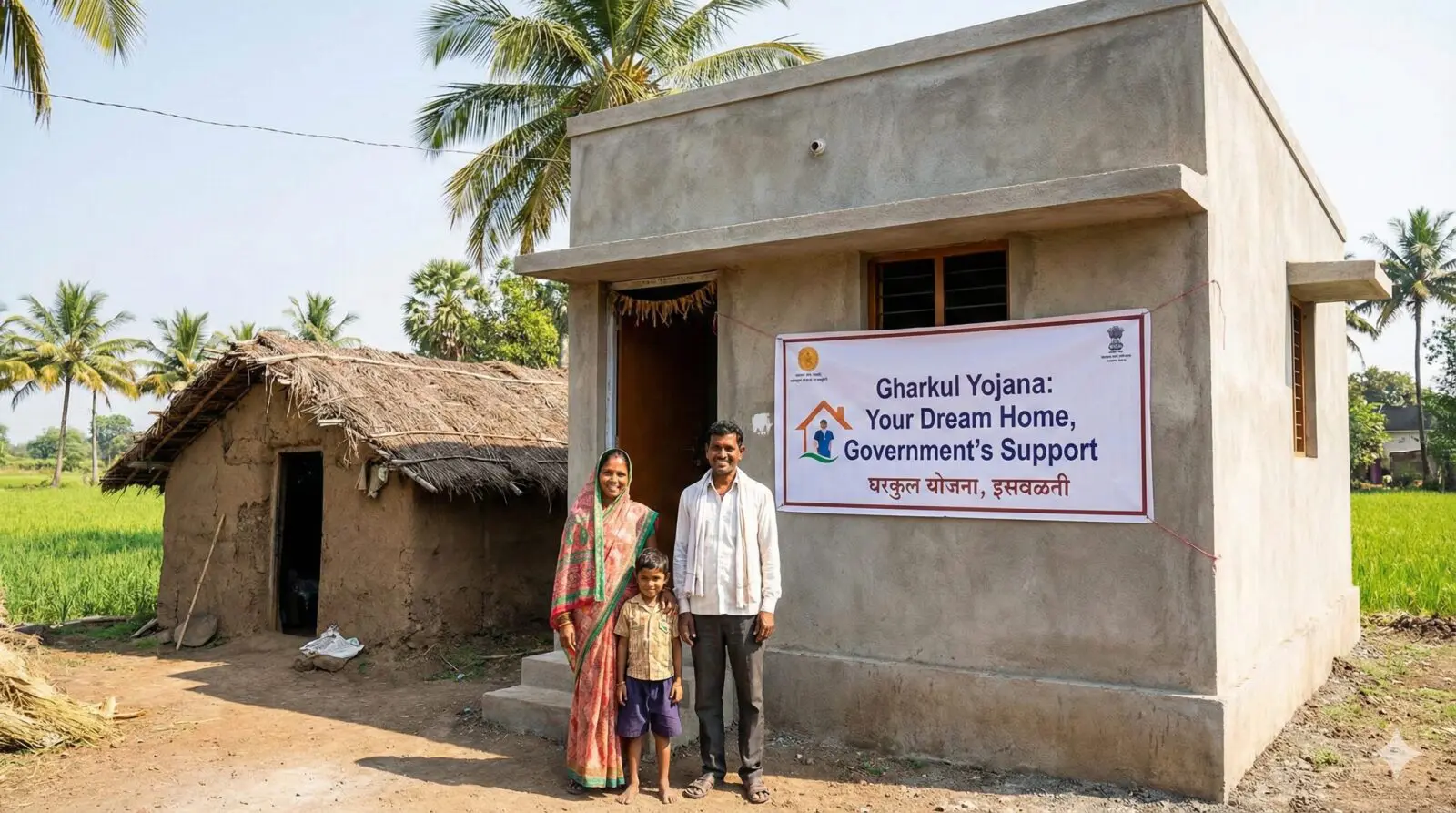
For every family in India, there is one dream that stands above all others. It isn’t buying a car, and it isn’t going on a fancy vacation. It is the dream of having a roof of your own—a “Khudra cha Ghar.”
In the villages of Maharashtra, this dream is even more important. Millions of families still live in kuccha houses made of mud, grass, or tin sheets. These homes leak when it rains. They get dangerously hot in the summer. They don’t offer the safety and dignity that every human being deserves.
But building a strong, concrete (pucca) house costs a lot of money. Cement, bricks, steel, and labour costs have gone up so much that a daily wage earner or a small farmer often feels like they will never be able to afford them.
This is where the government steps in. You might have heard people in your village talking about “Gharkul Yojana.” They say things like, “Has your Gharkul Yojanabeen approved?” or “I am applying for Gharkul Yojana.”
But what exactly is it? Is it a loan? Is it free money? How do you get it?
This article is your complete, simple guide. We will break down everything you need to know about the Gharkul Yojana (Ramai Awas Yojana and PMAY) so you can understand it clearly and claim the benefit you are entitled to.
What is the Gharkul Yojana?
First, let’s clear up a common confusion. “Gharkul” is not just one single scheme. In Maharashtra, “Gharkul” is a popular word used for government housing schemes that give money to poor families to build their homes.
Depending on your caste and category, the scheme has different names:
- Ramai Awas Yojana: This is for families belonging to the Scheduled Castes (SC) and Neo-Buddhist communities.
- Shabari Awas Yojana: This is specifically for Scheduled Tribe (ST) families.
- Pradhan Mantri Awas Yojana (Gramin): This is the central scheme for the rural poor of all categories who are on the eligible list.
The main idea behind all of them is the same: From Kuccha to Pucca.
The government wants to ensure that by the end of 2025, no family in Maharashtra is living in a dilapidated mud house or a temporary hut. The government does not build the house for you. Instead, they give you the money directly in your bank account, and you build the house yourself. This is great because it allows you to supervise the construction and ensure good quality materials are used.
Who is This Gharkul Yojana For?
The government has limited funds, so it cannot give a house to everyone. They have to prioritise the people who need it the most. Because of this, the rules for who can apply are quite strict.
The Priority Categories. The Gharkul schemes (especially Ramai Awas) are focused heavily on helpingmarginalisedd communities. You are eligible if you belong to the Scheduled Castes (SC), the Scheduled Tribes (ST), or the Neo-Buddhist communities. There are also provisions for Other Backwards Classes (OBC) and Open categories under different sub-schemes like the Yashwantrao Chavan Yojana, but the core “Gharkul” benefits are often directed toward SC/ST families first.
The “Homeless” or “Kuccha House” Rul..e This is the most critical rule. You can only apply if you do not already have a concrete house. If you are living in a hut, a mud house, or a temporary shelter made of tin sheets, you are eligible. However, if you or anyone in your immediate family (husband, wife, unmarried children) already owns a proper concrete house anywhere in India, you cannot apply. The government checks this thoroughly.
Income Lim::its This scheme is for the poor. Usually, families listed as “Below Poverty Line” (BPL) get first preference. If you have a BPL ration card (Yellow or Saffron card), your chances of approval are very high. Even if you don’t have a BPL card, you can apply if your annual family income is low (usually below ₹1 Lakh to ₹1.20 Lakh depending on the specific year’s rules).
The “Permanent Resident” Rule: You must be a permanent resident of Maharashtra. You will need to prove that you have lived here for many years, usually mostly by showing a Domicile Certificate or old voting proofs.
Who is automatically rejected? There are some clear “Red Flags.” If youmotorisedtorized vehicle like a car or a three-wheeler (sometimes two-wheelers are overlooked, but cars are a strict no), you are rejected. If anyone in your family has a government job, you are rejected. If you pay income tax or professional tax, you are considered “rich” by the government’s standards for this specific scheme, and you will not get the benefit.
How Much Do You Get in Gharkul Yojana?
This is the question everyone asks: “How much money will I get?”
The amount changes slightly depending on whether you live in a plain village area or a hilly/difficult area (like Naxal-affected districts), but here is the general breakdown for 2025.
The Housing Grant. For a regular rural area, the government usually provides a grant of around ₹1.20 Lakh. If you are in a hilly or difficult area, this might go up to ₹1.30 Lakh.
The Toilet Grant. In addition to the house money, the government wants every home to have a toilet. So, they provide an additional amount of roughly ₹12,000 under the Swachh Bharat Mission specifically for building a toilet.
The Labour Wage Benefit (MNREGA). Here is a hidden benefit many people miss. When you build your house, you need labourers, right? Under the MNREGA scheme (the employment guarantee scheme), you can register yourself as a labourer for your own house construction. The government will pay you wages for up to 90 days of work. This adds another ₹18,000 to ₹20,000 to your total benefit.
How the Money Reaches You:u The government will not give you a suitcase full of cash. They know that if they give ₹1.3 Lakhs at once, people might spend it on a daughter’s wedding or paying off old debts instead of building the house.
To prevent this, the money comes in Installments (or “Tappas”):
- First Instalment: You get this when your application is approved to start the work (digging the foundation).
- Second IInstalment You get this when the construction reaches the “Plinth” level (just above the ground).
- Third InInstalmentYou get this when the walls are built up to the window or door level (Lintel level).
- Fourth instalment to get this when you cast the roof (the slab).
- Final Instalment: You get this when the plastering is done, and the house is painted and finished.
You have to upload a photo of the house at every stage to get the next instalment.
How to Apply Gharkul Yojana?
Applying for Gharkul Yojana is not like ordering clothes online. You cannot just sit on your sofa and do it on a mobile app. It is an offline process that involves your local village office. Here is how the journey usually looks.
Step 1: The Visit to the Gram Panchayat. Your journey starts at your local Gram Panchayat office. You need to go there and meet the Gram Sevak. The Gram Sevak is the government officer responsible for your village. Tell them clearly, “I want to apply for the Gharkul Yojana (or Ramai Awas Yojana).”
Step 2: Getting the Form . Ask for the application form. Sometimes the Gram Sevak might say the forms are not available right now or the survey is over. Be persistent. Ask when the next survey will happen or if you can submit a form to be added to the waiting list (specifically the “D-List” or the ongoing permanent waiting list).
Step 3: The Importance of the Gram Sabha. This is the step where most people fail because they don’t know about it. In villages, major decisions are made during the Gram Sabha (Village Meeting). These meetings happen on specific days like August 15th, January 26th, May 1st, or October 2nd.
The list of people who will get houses is read out and approved in this meeting. You must attend this meeting. Stand up when the housing subject comes up. Ensure your name is written in the official register of the meeting. If your name is approved in the Gram Sabha, 90% of your work is done. If you are not on the Gram Sabha list, no officer in the district can help you.
Step 4: The “Geo-Tagging” Photo: Once your name is on the list, a surveyor (or the Gram Sevak) will visit your home. They will use a mobile app to take a photo of your current condition. They need to upload a photo of you standing in front of your kuccha house or hut. This is called “Geo-tagging.”
It proves to the government computer system that you actually live in poor conditions. Once this photo is uploaded, your “Job Card” for the house is generated.
What Documents are Required for the Gharkul Yojana?
You need to prove to the government that you are who you say you are. Having the right papers ready saves you months of delay.
1. Caste Certificate: Since schemes like Ramai Awas are caste-specific, this is your most important paper. It proves you belong to the SC, ST, or Neo-Buddhist community.
2. Income Certificate: You need a certificate showing your annual family income. You can get this from the Tahsildar’s office or the “Maha Seva Kendra” in your town. The income stated should be within the limits of the scheme.
3. Ownership Proof (7/12 Extract or Property Tax Receipt): You need to show that you own the land where you want to build the house. If you are a farmer, the 7/12 extract works. If you live in the village settlement (Gaothan), the Property Tax Receipt (called the Namuna 8 or Gharnond) from the Gram Panchayat is enough.
4. Aadhaar and Bank Passbook: This is crucial for the money transfer. Your bank account must be linked to your Aadhaar card. If your Aadhaar name is “Suresh Kumar” and your bank name is just “Suresh,” the computer might reject the payment. Make sure the names match exactly.
What If You Don’t Have Land?
This is a very common problem. Many poor families live in rented huts or encroach on public land because they don’t own any land of their own. Can they get a Gharkul?
For a long time, the answer was no. But now, the government has a solution called the Pandit Deendayal Upadhyay Gharkul Jaga Kharedi Yojana.
Under this special scheme, if you are eligible for a house but don’t have land, the government provides financial help (up to ₹50,000) specifically to buy a small plot of land. Once you buy the land using this money, you can then apply for the construction money separately. If you are landless, you must ask your Gram Sevak about this specific “Land Purchase” scheme.
Common Mistakes and How to Avoid Scams
Even with good intentions, people make mistakes that get their applications rejected.
The “Agent” Scam. In many villages, there are middlemen or “agents” who will come to you. They will say, “Your file is stuck at the district office. Give me ₹5,000, and I will pay the officer to release your money.” Never believe them. The Gharkul system is digital. The money is released automatically when the Geo-tagged photo is uploaded and approved. No officer sits with a button to release money manually. If you pay an agent, you are just throwing money away.
The “Wrong Photo” Mistake: When the surveyor comes to take a photo of your old house, be careful. If you stand in front of your neighbour’s concrete wall or a borrowed tractor, the computer system uses Artificial Intelligence to analyse the photo. If it sees a concrete wall or a vehicle, it assumes you are rich and rejects your application. Ensure the photo clearly shows your kuccha hut.
The “Joint Family” Confusion. If you live in a joint family and your father already has a house, but you want a separate one, it can be difficult. The government looks at the Ration Card. If your name is on a Ration Card that is already linked to a pucca house, you might be rejected. You often need a separate Ration Card to prove you are a separate household.
Construction Tips for the Common Man
Let’s be realistic—₹1.20 Lakh is not a lot of money to build a house in 2026. Material prices are high. If you hire a big contractor, the money willrun outh before the roof is built.
Here is how smart families manage to build good houses within the budget:
1. Use Fly Ash Bricks: Instead of expensive red clay bricks, use grey fly ash bricks. They are cheaper, stronger, and they are very flat, so you need less cement plaster on them.
2. Family Labour: In villages, families often don’t hire labourers for moving bricks, mixing cement, or curing the walls (watering). They do it themselves. This saves a huge amount of money on daily wages.
3. Simple Design: Don’t try to build a complex design with pillars and balconies. Keep the house square or rectangular. A simple box design is the strongest and cheapest to build.
Conclusion
The Gharkul Yojana is more than just a government file; it is a pathway to dignity. It is a chance to stop worrying about the rain leaking through the roof. It is a chance to give your children a safe place to study and grow.
The process can seem long. You might have to visit the Panchayat office many times. You might have to fix errors in your documents. But do not give up. This is your right. The government has funds allocated specifically for you, but you have to be proactive to claim them.
What you should do today: Go home and check your papers. Do you have your Caste Certificate? Is your Aadhaar linked to your bank? Once your papers are ready, go to the Gram Panchayat and ask when the next Gram Sabha is happening. That meeting is the first step toward your new home.
📩 If you notice any incorrect data in this guide or wish to share additional information, please write to us at info@indiansouls.in.
Over 2000+ Government Schemes & Policies Simplified
Indian Souls is your guide to government Schemes, scholarships, pensions, subsidies, job exams, and more. We break complex schemes into easy steps, helping every citizen take full advantage of the opportunities available.
No jargon. No confusion. Just useful info that helps indian citizen.



 Rajesh Tanwar











![12 Government Schemes for Urban Poor Must Know About [2025 Guide]](https://indiansouls.in/wp-content/uploads/2025/05/image-1.jpg "A Complete Guide to Maharashtra’s Gharkul Yojana 2026 - Indian Souls")




%20–%20A%20Complete%20Guide)


)
%20–%202025%20Complete%20Guide:%20Latest%20Updates,%20How%20It%20Works%20&%20Who%20Qualifies)
,%20Eligibility%20&%20Status%20Check)


:%2010000%20Rs.%20Monthy%20Stipened)


%20–%20Swachh%20Smart%20Toilets)
)

